



How Flexible Filling Systems Adapt to Multiple Bottle Types for Agrochemical Products
 Oct 21, 2026|
 View:235
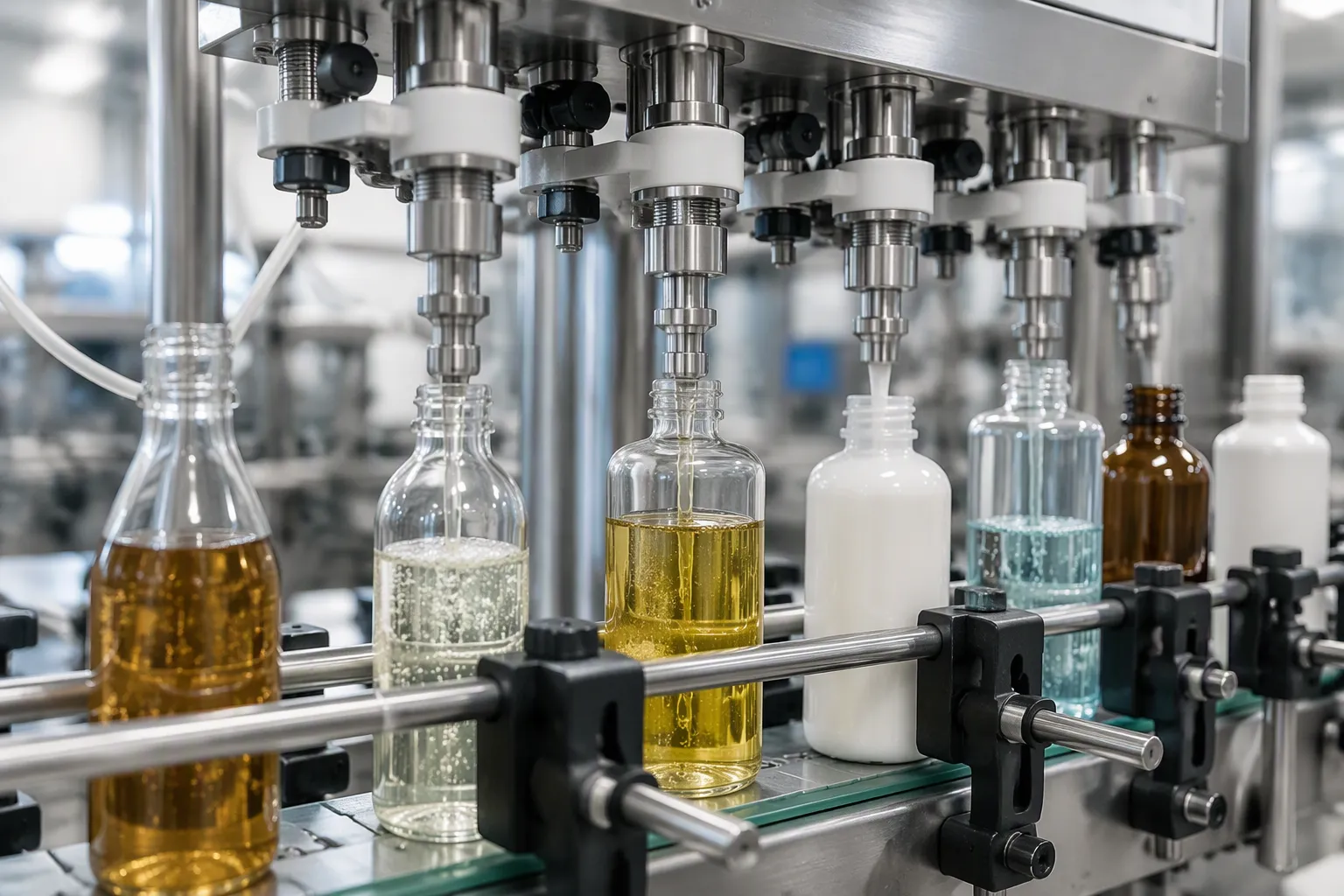
Flexible filling systems adjust using modular parts, sensor-based changes, and programmable controls. Bottles differ in shape, size, material, and neck finish. Agrochemical products add strict needs for dosing accuracy, containment, and regulatory compliance.
This adaptability lets one filling system handle many bottle formats. The sections below explain the mechanisms behind that flexibility, the changeover process, compliance handling, and the cost picture. Readers will see how flexible filling systems balance speed, precision, and safety across a growing product range.
Key Takeaways
Flexible filling systems use modular parts and sensors to handle many bottle shapes and sizes without big setup changes.
Programmable controls and quick-change tooling let operators switch bottle formats in minutes instead of hours.
These systems keep the dosing accurate and safe. They meet strict agrochemical rules for containment and traceability.
One flexible line can do the job of several single-purpose lines. This saves space and money over time.
Pick a flexible system if your product mix changes often. Choose a dedicated line for one bottle and formula at high volume.
Filling Challenges Across Multiple Bottle, Jar and Closure Formats
Dimensional and Material Variation
Bottle shape, size, neck finish, and material each create their own filling problems. A flexible filling system must handle a wide range of containers without treating every new format as a big setup problem. The table below sums up how common packaging variations affect filling equipment.
Packaging variation | Filling-system challenge |
|---|---|
Container material | Must be recorded to pick compatible feeding and capping structures |
Container dimensions | Guide, positioning, and conveyor setup depend on physical samples |
Neck finish | Different neck finishes need different feeding and capping structures |
Closure type | Screw caps, pump heads, and special closures each need their own feeding and capping structures |
Handle position | Handles on jerrycans cause shaky transfer during filling |
Cap or seal type | Capping modules are set up from physical samples |
Label position | Labeling and line layout must be adjusted |
Material choice matters too. The same plastic can act differently with different pesticide or fertilizer formulas, depending on thickness, makeup, and filling temperature. Bottle height, base stability, and neck diameter also affect accuracy and efficiency. A neck diameter that does not match the filling nozzle causes spills onto the bottle outside. Unstable bases make bottles wobble or tip on the conveyor. Testing several samples of any new bottle on the existing line before adoption is a smart safeguard.
Asymmetric bottles, narrow neck finishes, and handled jugs create local backpressure, forcing displaced air up through the incoming liquid stream and multiplying foam generation.
Agrochemical Handling Constraints

Agrochemical products add strict demands for dosing accuracy, containment, and operator safety. A closed handling system moves pesticide straight from the original container to a mixing valve, so people and the environment are not exposed to the concentrate during loading and mixing. Backflow prevention devices on wells or hydrants protect water supplies. A six-inch air gap between the hose and the top of the fill line stops reverse flow. Spill containment areas should hold 125% of the largest bulk container plus the displaced volume of other tanks. Operators must stay with the sprayer during filling, and restricted-use pesticides require supervision by a trained, certified applicator.
These constraints mean a filling system must support a variety of container types and containers of different specifications without compromising safety. Flexible filling systems can support a wider range of requirements instead of treating every new bottle or formula as a big setup problem. This ability matters for multi-format packaging across plastic bottles, glass, aluminum, and other packaging formats. A well-matched filling system handles this variety of container types and the full range of multiple bottle, jar and closure formats. Matching the container type to the right equipment keeps multi-format packaging efficient and compliant.
Technologies Behind Flexible Filling Systems
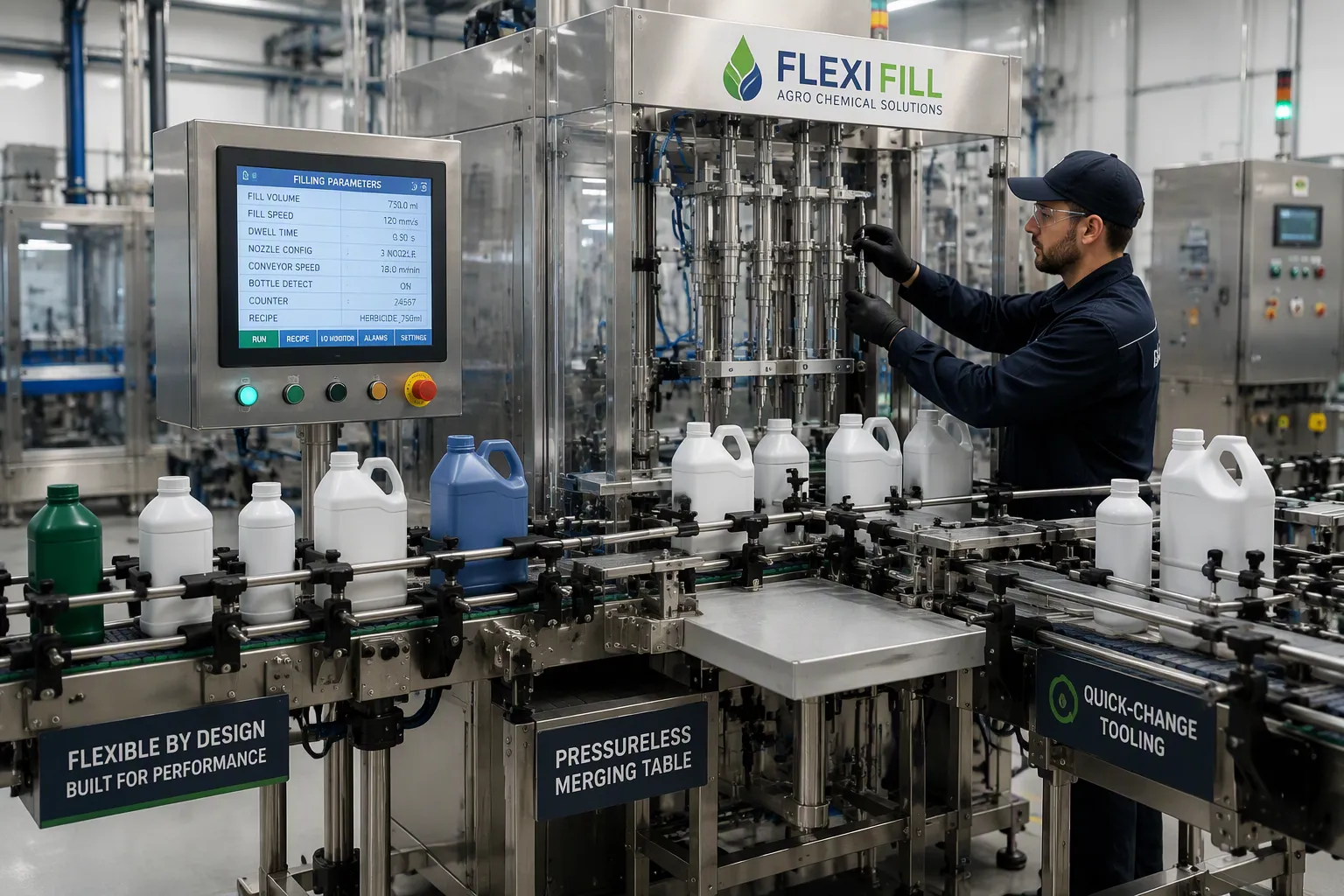
Adjustable Conveyors and Quick-Change Tooling
Conveyors are the main support of any flexible filling system. Modular sections let engineers add or remove line length when production needs change. The same line can be set up again for different product formats. Worn parts can be taken out and replaced without shutting down the whole line.
A custom solution keeps the production line running smoothly. This includes changing the conveyor system to fit unique bottle shapes and sizes, along with nozzle adjustments and special sensors for steady fill levels.
Layer gripping in the VacuGrip style holds HDPE bottles steady as they move. Pressureless merging over a storage table then feeds them to the filler without jams or scuffs. Together, these two functions let a single line accept a wide range of containers.
Feature | How it improves flexibility for different bottle types |
|---|---|
Touchscreen controls with stored parameters | Operators recall saved settings through the HMI instead of doing mechanical rebuilds, cutting changeover from 30–60 minutes to minutes |
Bottle stabilizing clamps | Hold containers in the same position no matter their size or shape, reducing trial runs to dial in placement |
Accurate gating mechanisms | Cut adjustment time when switching container sizes and shapes |
Flexible fill range (2–4 piston nozzle configurations) | Handles products from 10ml to 1000ml without mechanical rebuilds |
Quick-change tooling follows the same idea. Adjustable syringe sizes, multi-nozzle systems, and compatible filling heads let one automatic liquid filling machine serve many bottle mouths. Operators switch while the line is online, so it keeps moving.
Vision Systems and Programmable Controls
Programmable logic controllers (PLCs) give filling equipment exact command over fill parameters. A PLC-driven design such as Size-Shift Fill-Cap adapts to many bottle sizes without manual changeovers. The operator picks a recipe, and the machine sets its own timing and volume.
Technology | Role in Filling Systems | How It Supports Adaptation |
|---|---|---|
Machine vision systems | Check bottle alignment to improve filling accuracy and catch discrepancies | Allows handling of different bottle types by checking positioning and boosting quality control, preventing costly errors |
Programmable Logic Controllers (PLCs) | Give precise control over filling parameters and enable automation | Allows adjustment of fill settings for various agrochemical products while reducing manual work, improving consistency and efficiency |
Vision systems add a second layer of assurance. Cameras check each container type as it arrives. A misaligned bottle triggers a correction before the nozzle fires. This feedback loop protects dosing accuracy across every container size on the schedule.
Tompacks shows these principles in hardware. The DGP-SCZ-12 automatic weighing type filling machine pairs sensor-driven weighing with programmable control. The DGP-Z-D 50-1000ML PLC controlled piston filling machine covers a wide volume band through recipe recall. Both machines show how a modern liquid filling machine adapts through software and sensors rather than mechanical rebuilds. Buyers comparing filling systems will find that programmable, sensor-driven designs deliver the widest format coverage.
Streamlining Changeovers for Multi-Viscosity Filling
Changeover Steps and Time Reduction
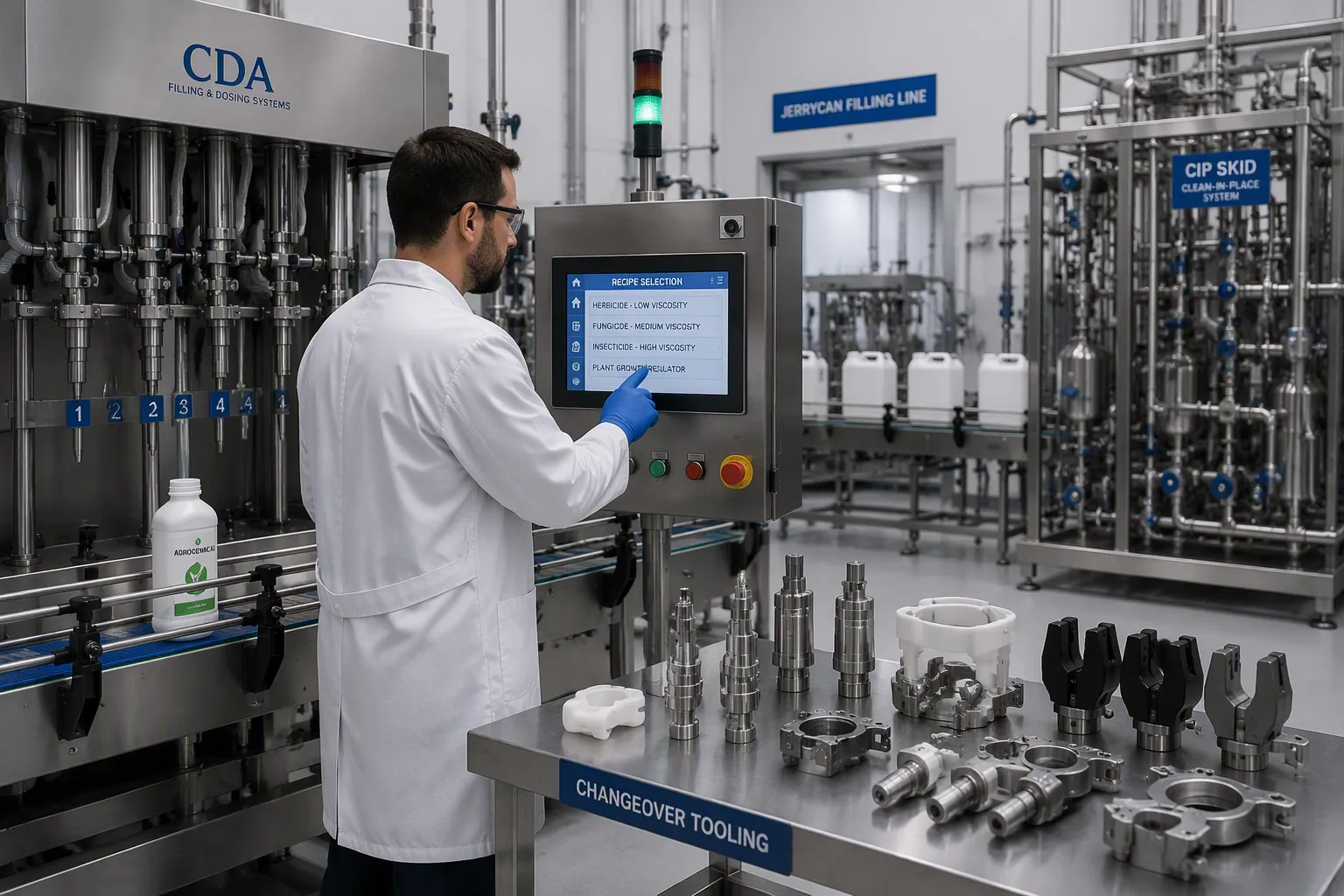
A clear changeover plan keeps downtime short and easy to repeat. The operator begins with recipe recall. The controller loads saved filling settings for the new bottle and product, so no one sets volumes by hand. Next comes the tooling swap. Nozzles, filling clips, and gripper jaws are changed to fit the new container type. The crew then adjusts the conveyor guides and sensors for the new bottle footprint. A short test run checks fill weight, cap fit, and label position before full output starts again.
Servo-driven filling systems can be reprogrammed quickly for different products. This shortens setup time and cuts the downtime that product changeovers usually cause. Traditional setups need long manual recalibration between pesticide formulas, which takes a lot of labor and adds downtime. Programmable servo control directly fixes this bottleneck. Automated clean-in-place cycles add another gain. Manual cleaning stretches changeover and cleaning cycles, while automated clean-in-place allows fast internal cleaning between batches. Jerrycan equipment built for flexibility also allows quick changeover between jerrycan sizes without re-engineering, which removes a common cause of delay.
Balancing Flexibility with Throughput
Multi-viscosity filling covers thin liquids, thick pastes, and products with or without particles. Matching the fill method to the product protects both speed and accuracy. Thin, non-foaming products below 100 cP suit gravity or overflow fillers, which deliver high throughput with simple hardware. Products above 1,000 cP or with particulates need a displacement system as the baseline. Pump fillers offer the broadest range: gear pumps for medium-viscosity accuracy, peristaltic pumps for corrosive or shear-sensitive liquids, and lobe pumps for gentle handling of viscous or particulate products. Piston fillers hold steady volumes on thick and particulate products.
Strategy | How it balances flexibility and throughput |
|---|---|
Adjustable guides, change parts, recipe management | One automated system covers many container sizes and formats |
Pump fillers | Configurable from thin to high-viscosity products with flexible fill volumes |
Inline configuration | Suits frequent changeovers and a wide product range |
Rotary configuration | Fills multiple containers at once for high-volume continuous output |
A staged approach works well. Producers start with gravity or overflow filling for thin liquids in small packages, then upgrade to displacement or pump technology as viscosity and package size grow. This confirms a proven process before investing in expensive machinery. Fast changeovers on a flexible filling line pay off most when the product mix shifts often. A dedicated line still wins when one bottle and one formula run continuously at high volume. Quick-change tooling fits the middle ground, where several packaging formats share one line and a quick production changeover keeps output steady. The multi-viscosity capability of a modern liquid filling machine therefore comes from matching hardware to the product range, not from forcing one design onto every duty.
Agrochemical Compliance in Filling Equipment
Accuracy, Containment, and Safety Features
Getting the right dose is the heart of agrochemical compliance. Advanced sensors and feedback systems keep filling amounts within tight limits. This stops pesticides from being over-filled or under-filled. Adjustable filling lances work for both top-fill and sub-surface fill jobs. That means one machine can handle thin solutions and thicker formulas alike. Built-in load cell platforms add automatic tare, gross weight checks, and net weight compliance. Together, these features give steady dosing accuracy in every batch.
Containment and operator protection finish the job. Flexible filling systems for this work usually include:
Automated pneumatic or robotic bunging and capping to make leak-proof seals
Explosion-proof parts and safety barriers rated to ATEX, IECEx, and NFPA for hazardous liquid settings
Built-in fume extraction and spill containment systems
Emergency shut-off systems and ventilation that meet OSHA and EPA standards
These safeguards protect operators and the environment during every fill cycle. They also keep accurate metering steady when formulas or bottle formats change between production runs.
Traceability and Documentation
Audit readiness depends on records that build themselves. Production stops on its own when material lots, formulations, or weights do not match. This catches compliance failures before they reach the market. Every step enforces checks, sign-offs, and cleanouts aligned to EPA, APVMA, REACH, and GHS protocols. Full traceability is logged in real time from raw intake through bulk bag filling. This removes manual re-entry and missing data. AgChem-ready workflows include zoning, SDS, expiration, and incompatibility rules that stay audit-ready without customization.
A programmable liquid filling machine supports this record-keeping through recipe logs and batch records. Operators recall a saved recipe, and the controller documents the parameters used for each run. Structured changeovers then leave a clear trail of tooling swaps and verification checks. Tompacks offers agrochemicals filling packaging solutions and turnkey agrochemical packaging machines built for precision and durability. This gives producers a liquid filling machine platform that meets these documentation demands.
Cost and ROI of Flexible Filling Systems
Investment Factors and Operating Savings
A flexible system costs more up front than a machine built for just one format. Buyers pay for modular hardware, extra tooling sets, and the controls that store recipes. Training operators adds another cost to the budget. Crews must learn recipe recall, tooling swaps, and verification checks before the line runs at full speed.
Savings from running the system build over time and often outweigh that extra cost. Less changeover time turns setup hours into production hours. One flexible line can replace several dedicated lines, which cuts floor space, spare parts stock, and duplicate maintenance. Fewer dedicated lines also lower the cost of every new bottle launch, because the existing equipment takes on the format instead of demanding a new machine.
Matching Types of Liquid Filling Machines to Product Mix
The right machine family follows from container type, liquid characteristics, production volume, and filling capacity. The table below shows how machine families map to that mix.
Machine family | Container types served | Throughput / capacity range |
|---|---|---|
Semi-automatic | Bottle, Jerrycan, Pail, Drum, Pallet | Short runs; small volumes from ~3.5 oz |
Step-by-step | Bottle, Jerrycan, Pail, Drum | Up to ~1,080 containers/hour (bottles) |
Rotary filler capper | Bottle, Jerrycan, Pail | Up to ~36,000 containers/hour (bottles) |
Linear robotic | Pallet | Large-format / pallet-level filling |
Flexible systems fit best when the product mix shifts often and packaging formats vary. Dedicated equipment still wins when one bottle and one formula run nonstop at high volume. Quick-change tooling and a simple machine interface allow fast changeovers between containers and products, which supports multi-format packaging and versatility across a growing portfolio. Large plants filling IBCs and drums up to ~330 gallons rely on EX UL or explosion-proof (ATEX) designs, while smaller non-flammable operations run bottles, pails, or jerrycans on standard builds. Flexible production lines built this way let one liquid filling machine serve many duties.
Tompacks delivers turnkey solutions and a broad product range as scalable examples. The rotary weighing type filling and capping machine suits high-volume output. The horizontal automatic packaging machine for liquid fertilizer and veterinary drugs covers a different duty. Each liquid filling machine in the range gives producers a clear path to scale.
Flexible filling systems adjust by using modular hardware, sensor-driven changes, programmable recipes, and organized changeovers. Each of these features removes a manual step when switching between bottle formats. Together, they let one line handle many containers without losing dosing accuracy or containment. That balance of flexibility, efficiency, and compliance defines a well-matched agrochemical filling setup.
Producers can grow this flexibility as their product lines expand. Saved recipes and quick-change tooling take on new bottle sizes and formulas without rebuilding the whole line. A staged approach keeps the investment matched to real demand. The result is a filling operation that stays precise, safe, and ready for the next format.
FAQ
What makes a filling system flexible?
Modular conveyors, quick-change tooling, and programmable controls give a system its flexibility. Operators recall saved recipes instead of rebuilding the machine. Sensors and vision systems check each bottle as it arrives. These parts work together, so one line accepts many container formats without a major setup effort.
How long does a bottle changeover take?
Changeover follows a fixed sequence: recipe recall, tooling swap, conveyor adjustment, then a short verification run. Stored settings cut the work sharply compared with mechanical rebuilds. The exact time depends on the machine and the bottle. A trained crew finishes the steps faster and makes fewer mistakes.
Can one machine fill thin and thick agrochemical products?
Yes. Gravity or overflow fillers work well for thin liquids that do not foam. Piston and pump fillers handle thick products and formulas with particles. Operators change nozzles and adjust settings to match each product. Matching the fill method to the liquid protects both speed and dosing accuracy across the product range.
How does the equipment support regulatory compliance?
Load cells and feedback sensors keep fill weights within tight limits. The controller logs recipes and batch records in real time. Built-in containment, fume extraction, and emergency shut-off systems protect operators. These features keep the line audit-ready when formulas or bottle formats change between runs.
When does a dedicated line make more sense?
A dedicated line wins when one bottle and one formula run nonstop at high volume. Flexible systems fit best when the product mix changes often and packaging formats vary. Quick-change tooling covers the middle ground, where several formats share one line and steady output matters.
Recent News
1.Why High Accuracy Filling Machines Ensure Stable Production for Agrochemical Enterprises
2026-10-162.Tom Packs Delivers Smart Filling Lines for Global Agrochemical Plants
2026-09-093.How Labor Costs Cut by 60% with Automated Agrochemical Filling Lines
2026-08-044.±0.5% Precision: TOM’s Intelligent Filling Line for Agrochemicals
2026-07-275.The best filling machine manufacturer for Agrochemical In china
2026-01-096.Agrochemical Filling Lines | Precision, Automation, and Efficiency
2025-05-13