



Liquid Fertilizer Packaging Line: Flexible Filling for 1L to 25L Pouches and Bottles
 Nov 12, 2026|
 View:10
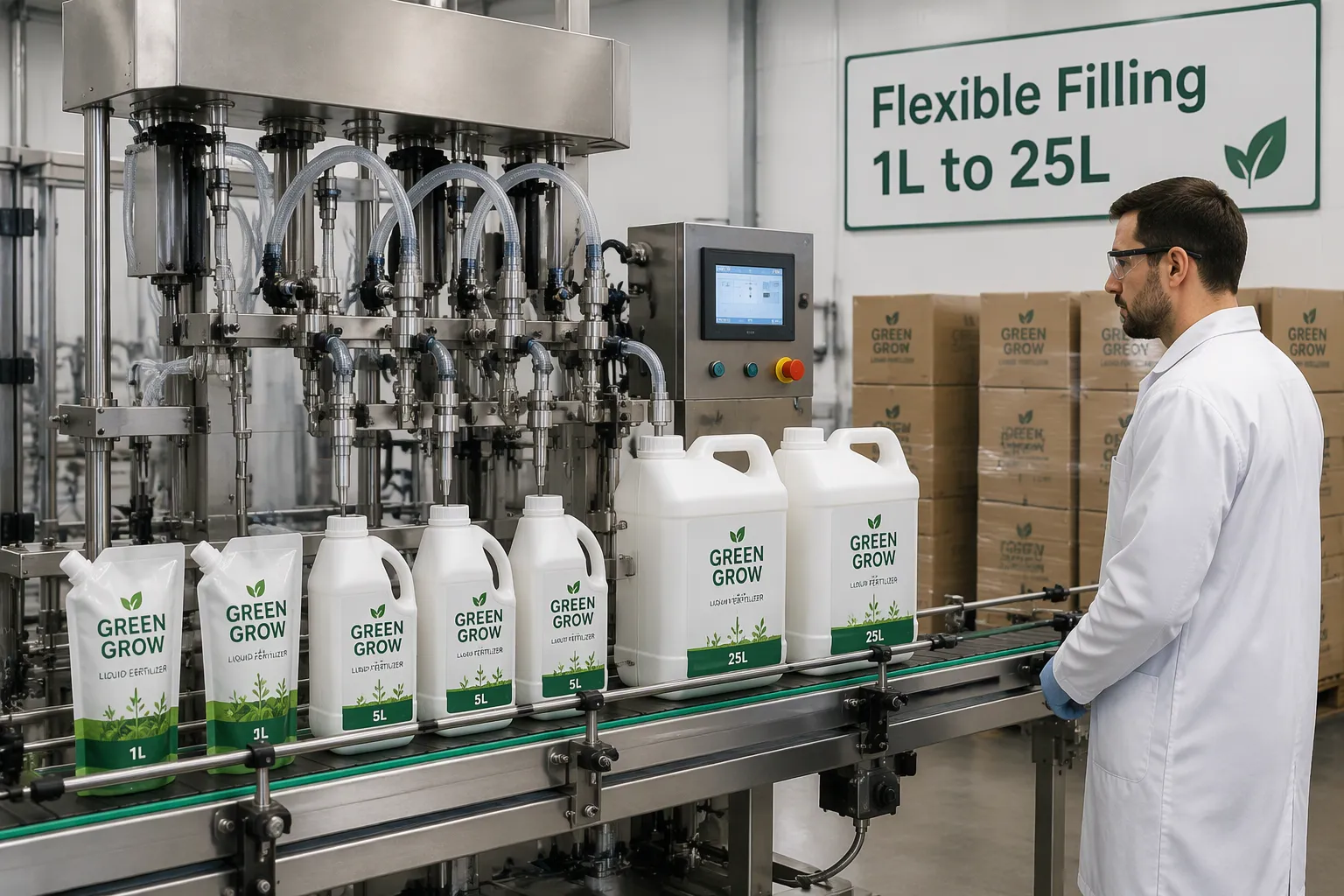
One liquid fertilizer packaging line can fill both pouches and bottles from 1L to 25L. Modular filling stations, quick-change tooling, and adaptive controls make this wide range practical. In most operations, bottles handle the smaller volumes. Pouches and stick bags go up to 25L.
This guide covers the design needs for such a line. It looks at pouch and bottle filling solutions, compares the two formats, and explains how fast changeovers work. It also pays close attention to compliance and cost.
Key Takeaways
One flexible line fills both pouches and bottles from 1L to 25L by using modular stations and quick-change parts.
Pouches are good for large amounts and save money on shipping and storage; bottles work best for small amounts and for closing again.
Quick-change tooling and recipe-driven controls make format switches fast and keep fill accuracy steady.
Both formats must follow U.S. fertilizer labeling rules, so check label space and material compatibility early.
Figure out the total cost of ownership for each format, including changeover time, to keep the line profitable.
Designing a Flexible Liquid Fertilizer Packaging Line
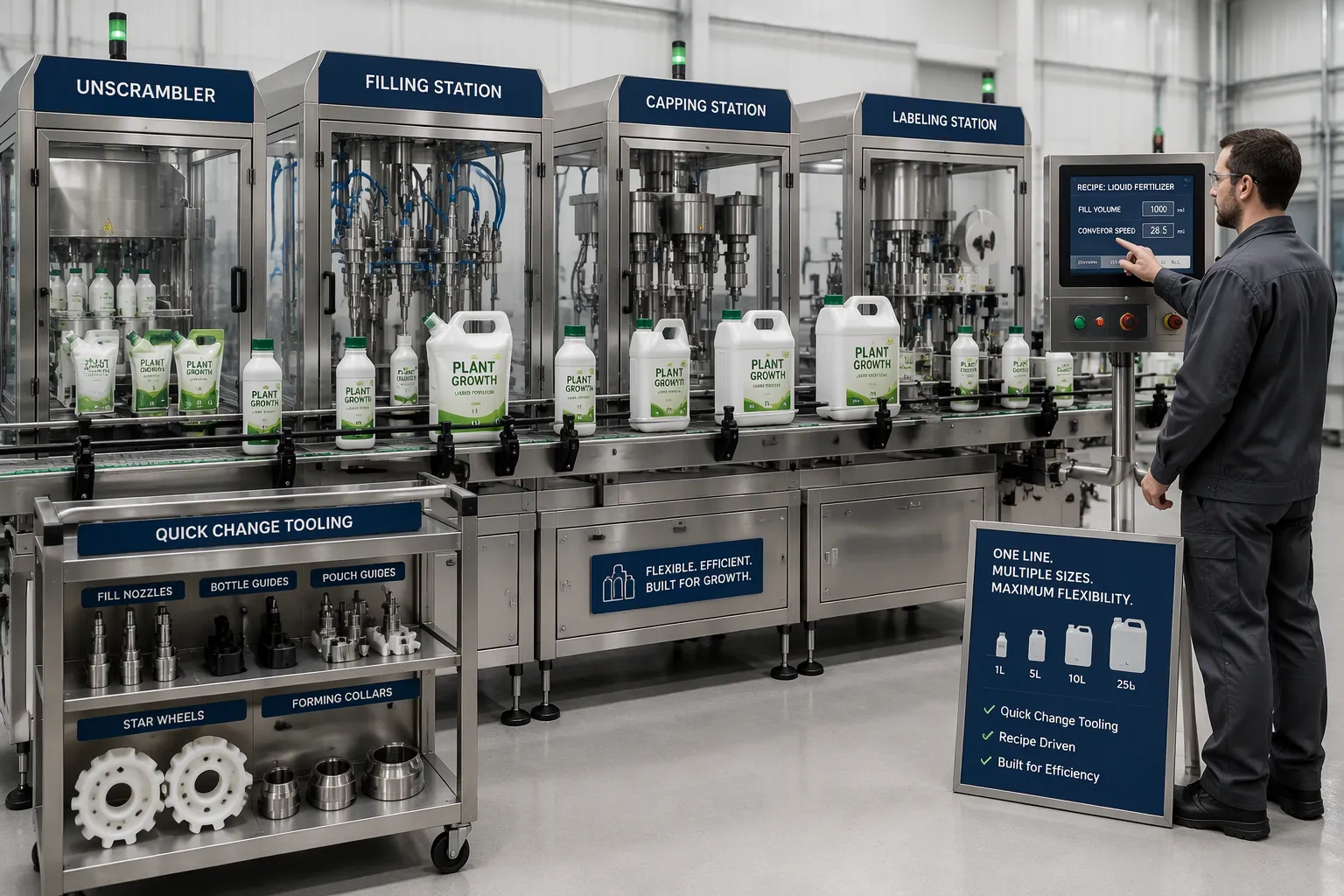
A flexible liquid fertilizer packaging line depends on three main design ideas. Modular filling stations can handle different kinds of containers. Quick-change tooling lets workers swap format-specific parts in just minutes. Adaptive control systems adjust fill settings without any mechanical rework. Together, these features let one line handle pouches, stick bags, and bottles across the full 1L to 25L range.
Modular Stations and Tooling
Modular stations split the line into separate jobs: container unscrambling, filling, capping, labeling, and case packing. Each station works as its own module with standard connections. A pouch filler and a bottle filler can share the same conveyor backbone and control setup. This design lets operators add capacity or switch formats without rebuilding the whole line.
Quick-change tooling makes switching formats practical. Change parts include filling nozzles, container guides, star wheels, capping chucks, and forming collars for stick bags. Each part has its own mounting point and fasteners that need no tools or just one tool. Operators pull one set off, put the next one on, and check alignment with locating pins. Labeled tooling carts keep each format set organized and lower the risk of misalignment. Changing from a 1L bottle to a 5L pouch becomes a simple parts swap instead of an engineering project.
Station size follows the product mix. A line built for 1L bottles needs compact fill heads and short indexing. A line built for 25L pouches needs wider conveyors and heavier support frames. Modular frames can hold either setup on the same footprint.
Adaptive controls tie the system together. Recipe-driven PLC programs store fill volume, nozzle timing, conveyor speed, and capping torque for each product and container pairing. An operator picks the recipe, and the line sets itself up. Sensors check fill levels and send corrections back to the filler in real time.
Changeover Speed and Fill Accuracy
Fill accuracy expectations change with volume. Small bottles in the 1L range need tight control, because a small absolute error is a large share of the target volume. Large 25L pouches can handle a wider absolute band, but the line must still meet the labeled net content. Volumetric fillers work well for low-viscosity fertilizer solutions. Weighing-type fillers work well for formulations where density shifts between batches.
Accuracy stays steady across formats through three practices. First, recipe storage keeps validated parameters for every container and product pair. Second, load cells or flow meters check each fill and trigger automatic correction. Third, nozzle design matches the product: anti-drip nozzles for bottles, wider bore nozzles for viscous suspensions in pouches. Switching between volumetric and weighing modes is a recipe setting on adaptive lines, so the same filler handles both thin and dense products.
Operators should check accuracy after every changeover. A short run of sample containers, weighed on a calibrated scale, confirms the line meets net content rules before full production starts again. This step takes minutes and guards against costly overfills or underfills. Control systems also log fill data for traceability. Trend monitoring helps operators spot drift before it goes past limits.
Changeover time depends on how many parts are in the set and how easy the mounting points are to reach. Designers put fasteners on one side of each station to make the swap shorter.
Pouch Filling for 1L to 25L
Technologies and Format Fit
Pouches and stick bags handle the larger volumes on a liquid fertilizer packaging line. Flexible film blocks light, oxygen, and moisture. This keeps sensitive formulas strong during storage and transport. Form-fit pouch designs also add real value in the field. UN-certified containers with shaped shoulders and controlled pour spouts cut down on glugging and splashing. This helps when a grower empties a 20L pouch into a spray tank.
Gravity fillers work well for thin fertilizer solutions and keep a steady flow into pouch necks. Piston fillers handle thicker suspensions and give repeatable volume control from 1000 to 5000ml. Anti-corrosion designs matter here. Wetted parts made of corrosion-resistant alloys and sealed drive components protect the filler from harsh salt solutions. Form-fill-seal stations build the pouch, fill it, and seal it in one pass. This keeps the film clean and the seal reliable.
Performance and Cost Profile
Pouches offer strong material efficiency. A flexible film uses less material per liter than a rigid container. Empty pouches also ship flat, so storage and freight costs stay low. Fill speeds on modern pouch lines run high, and the format scales easily from 1L stick bags to 25L bag-in-box styles. Sealing quality drives performance. Operators must control seal temperature, pressure, and dwell time for each film structure. Routine seal-strength checks protect against leaks.
Costs change with the format. Film and forming tooling carry their own price profile. Changeover parts for different pouch sizes add to the tooling inventory. Pouches also need careful handling on the conveyor to avoid punctures. Overall, the format fits operations that prioritize low shipping weight, compact storage, and single-use convenience. A well-matched filler and film combination keeps reject rates low and protects the product through the full distribution chain.
Bottle Filling for 1L to 25L
Technologies and Format Fit
Bottles usually handle the smaller volumes on a liquid fertilizer packaging line. Many designs also include handy features for use in the field. Molded measuring scales let growers measure product without a separate cup. Anti-drip spouts and vented necks keep pours clean and cut down on waste. Small bottle lines run the whole sequence: an unscrambler sorts and turns containers the right way, a filler adds product, and capping and labeling stations finish the pack. High-accuracy linear fillers work well for 100ml to 1L plastic bottles, where tight net-content control matters most.
Larger bottle formats go up to 25L for operations that like rigid containers. These bottles need heavier conveyors, wider guides, and fill heads made for bigger doses. Handle designs and wide-mouth openings make emptying easier for end users. Piston fillers and weighing-type fillers both work well here. Corrosion-resistant wetted parts also protect the equipment from harsh salt solutions.
Performance and Cost Profile
Bottles give you rigidity and stack strength. A filled bottle keeps its shape on a pallet and survives rough handling in transit. The format also lets you reseal it, so a grower can use part of a container and store the rest. Fill accuracy on linear bottle lines stays strong across the volume range. Recipe-driven controls hold those settings through changeovers.
Costs follow the format. Rigid containers weigh more and cost more in material and freight than flexible film, and blow-molded stock needs storage space. Tooling for multiple bottle sizes adds to the change-part inventory. Bottles still fit operations that value durability, resealability, and shelf presence. A matched filler, capper, and torque setting keep reject rates low and protect product integrity through distribution.
Pouch vs. Bottle on a Liquid Fertilizer Packaging Line
Performance and Application Fit
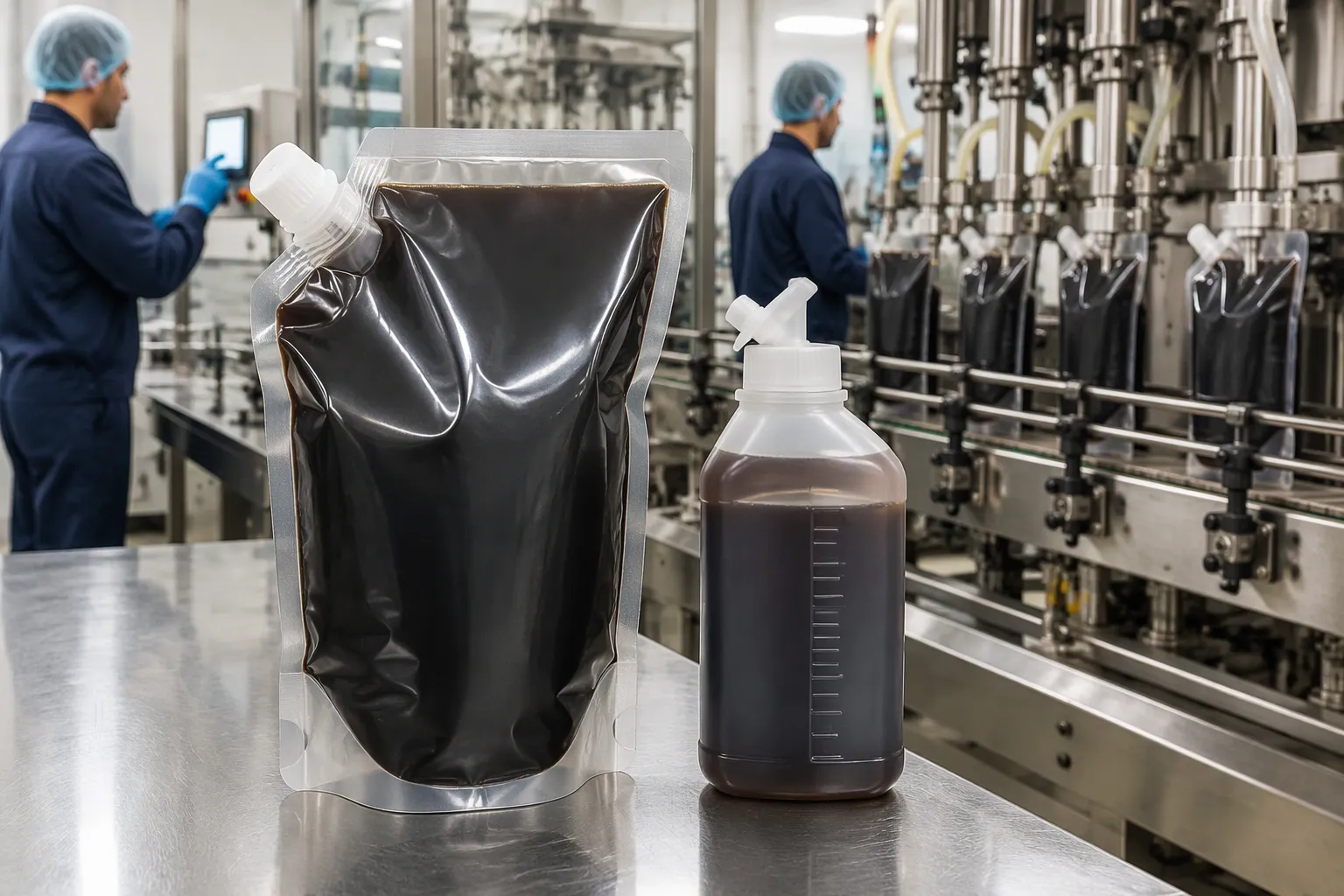
Each format has its own job in the product mix. Pouches and stick bags work best for larger volumes, from 5L up to 25L. Flexible film uses less material per liter, ships flat, and stores in a small space. A grower pours a 20L pouch into a spray tank in one pour, then throws the empty away. This single-use model works well for large field jobs and bulk refill programs. Form-fit designs with controlled pour spouts cut down on glugging and splashing during transfer.
Bottles work best for smaller volumes and for uses that need resealing. A 1L bottle with a molded measuring scale lets a grower mix a partial dose and store the rest. Rigid walls hold their shape on a pallet and survive rough handling in transit. Anti-drip spouts keep pours clean. Small bottle lines run unscrambling, filling, capping, and labeling in one sequence. High-accuracy linear fillers hold tight net-content control in the 100ml to 1L range.
Neither format wins in every case. Pouches fit high-volume, single-use, and freight-sensitive operations. Bottles fit precision dosing, resealability, and shelf presence. Many operations run both formats on one liquid fertilizer packaging line and let the order book decide the daily schedule.
Compliance and Cost Comparison
Regulatory rules shape format choice. UN certification applies to certain container types for transport of regulated goods. Pouches with UN-certified form-fit designs meet these rules for specific packagings. Bottles may also need UN marks depending on volume and contents. U.S. fertilizer labeling rules require net content statements, guaranteed analysis, and proper warnings on every package. Both formats can meet these rules. The label space differs: a pouch offers a broad flat panel, while a bottle offers a curved surface with a smaller printable area.
Cost profiles split apart across the life of the line. Pouches save on material weight and freight. Empty pouches ship flat, so warehouse space stays low. Film and forming tooling carry their own price tag, and each pouch size adds a change part to the inventory. Bottles cost more in resin and freight, and blow-molded stock needs storage room. Tooling for multiple bottle sizes adds to the change-part set. Fill accuracy and reject rates depend more on the filler match than on the format itself.
Factor | Pouch | Bottle |
|---|---|---|
Typical volume fit | 5L to 25L | 100ml to 25L |
Material and freight cost | Lower per liter | Higher per liter |
Storage of empty stock | Flat, compact | Bulky |
Resealability | Single use | Resealable |
Label area | Broad flat panel | Curved, smaller |
UN-certified options | Available | Available |
A fair comparison weighs these factors against the actual product mix. Operations with high-volume field products lean toward pouches. Operations with precision dosing and retail shelf needs lean toward bottles. A shared line covers both.
Changeover and Operational Efficiency
Quick-Change Parts and Cleaning
Quick-change parts cut downtime on a shared line. Operators swap nozzles, guides, star wheels, and capping chucks as complete sets. Tooling carts keep each format set labeled and within reach. Locating pins guide each part into place, so alignment checks take seconds. A crew can move from a 1L bottle run to a 5L pouch run without calling in maintenance.
Cleaning routines protect product quality between fertilizer formulations. Leftover salts and suspensions can clog nozzles and spoil the next batch. Operators flush the product path with water or a compatible rinse, then run a short purge cycle. Removable fill heads and smooth wetted surfaces make this step faster. A written cleaning checklist for each formulation family keeps the routine the same across shifts.
Scheduling and Line Utilization
Smart scheduling keeps a shared line busy. Planners group runs by container format and fill volume, so changeovers happen once per group instead of once per order. They run light-colored formulations before dark ones, which cuts cleaning work between batches. Recipe-driven controls store validated settings for every product and container pair, so setup after a changeover is quick and repeatable.
Line utilization improves when planners treat changeover time as a scheduled task, not a surprise. A short sample run after each switch confirms fill accuracy before full production resumes. Buffer zones before and after the filler absorb small stoppages and keep the line moving. Together, these practices let one liquid fertilizer packaging line serve pouches, stick bags, and bottles across the full 1L to 25L range without long idle periods.
Compliance and Total Cost of Ownership
Fertilizer Regulations and Material Compatibility
U.S. fertilizer rules say every package needs a net content statement, a guaranteed analysis, and proper hazard warnings. State-level registration adds one more step for some products. Pouches and bottles can both carry these labels, and UN-certified packaging covers shipping of regulated goods. Designers should confirm label space early, because a curved bottle surface holds less text than a wide pouch panel.
Corrosive formulas put every wetted part on the line to the test. Salt solutions and acidic blends eat away ordinary steel, so fill heads, nozzles, pumps, and product lines need corrosion-resistant alloys and sealed drives. Operators should check elastomer seals against each formula family. A material that survives one fertilizer may swell or crack in another. A compatibility chart, built from supplier data and short soak tests, protects the equipment and the product.
Evaluating Total Cost of Ownership
Purchase price is only the first line in the budget. A liquid fertilizer packaging line carries costs across its whole life: film and resin, change parts, spare seals and nozzles, cleaning chemicals, energy, and operator time. Changeover duration matters here. A line that switches formats in minutes frees up capacity that a slower line loses to idle time.
Planners should add up these costs per format and per volume band. Pouches save on material weight and freight. Bottles cost more in resin and storage, yet they offer resealability and shelf presence. Tooling inventory grows with every container size added to the mix. A simple spreadsheet, updated yearly with real consumption data, shows which format earns its place. That same sheet guides decisions on spare-part stock and cleaning schedules, and it keeps the line profitable over its full service life.
A flexible line pays off when you plan carefully before the first machine shows up. Buyers should match modular stations and tooling to the real product mix. Then they should weigh pouch and bottle fit against compliance needs and cost per format. Changeover and cleaning workflows need attention up front, because they decide how much uptime the shared line delivers.
A short checklist keeps the decision on track:
List every container format and fill volume the line must run.
Confirm modular stations and quick-change parts cover that list.
Compare pouch and bottle options on compliance, freight, and storage.
Map changeover steps and cleaning routines for each formulation family.
Check fill accuracy targets for the smallest and largest volumes.
FAQ
Can one line really fill both pouches and bottles without a full rebuild?
Yes. Modular stations share a common conveyor backbone and control setup. Quick-change tooling swaps nozzles, guides, and capping chucks as complete sets. Recipe-driven controls then load the right fill settings. Operators move between formats with a parts swap, not an engineering project.
How does the line keep fill accuracy steady after a format switch?
Recipe storage keeps saved settings for every container and product pair. Load cells or flow meters check each fill and start automatic correction. After each changeover, operators run a short sample batch on a calibrated scale. This confirms net content compliance before full production starts again.
Which format suits a grower who mixes partial doses?
Bottles fit this job best. Molded measuring scales let a grower measure product without a separate cup. Resealable walls let them store the rest. Pouches suit single-use, high-volume field work instead, where a grower empties the whole container in one pour.
What drives cleaning time between fertilizer formulations?
Leftover salts and suspensions can clog nozzles and spoil the next batch. Operators flush the product path, then run a short purge cycle. Removable fill heads and smooth wetted surfaces make this step faster. A written checklist per formulation family keeps the routine the same across shifts.
Do both formats meet U.S. fertilizer labeling rules?
Yes. Every package needs a net content statement, a guaranteed analysis, and proper hazard warnings. Both formats can carry these labels. Designers should confirm label space early, because a curved bottle surface holds less text than a wide pouch panel.