



How a Turnkey Lubricant Packaging Line Works: From Jerrycan Filling to Capping and Carton Packing
 Nov 02, 2026|
 View:1
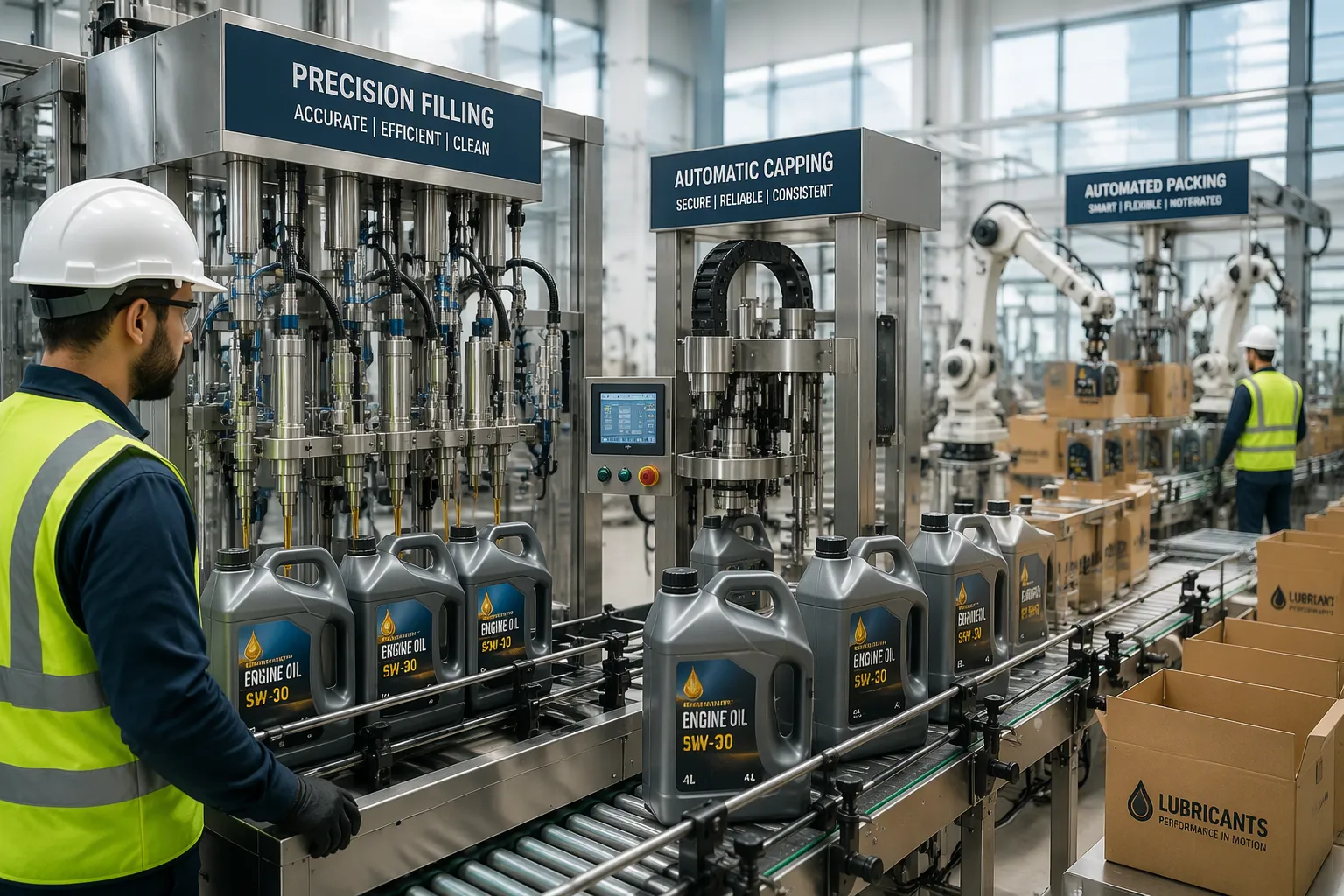
A turnkey lubricant packaging line is a single-supplier system. It moves jerrycans through filling, capping, and carton packing with little on-site setup. One supplier delivers the connected equipment, and the line runs as a coordinated whole.
The flow follows a clear order. Jerrycan filling puts lubricant into each container with controlled accuracy. Capping then feeds and tightens caps to form a secure seal. Carton packing finally lanes the filled jerrycans, loads them into cases, and seals each carton for shipment.
Readers will learn how each stage works and which equipment and automation carry it out. They will also learn what to weigh when choosing a turnkey lubricant packaging line for their own production targets.
Key Takeaways
A turnkey line comes from a single supplier and works as one coordinated system.
Filling accuracy depends on the type of filler; net-weight fillers give the tightest tolerance.
Capping torque control stops leaks; servo systems give the best precision.
Carton packing machines handle lane forming, case loading, and sealing automatically, so products ship out efficiently.
Using one supplier lowers the risk of parts not fitting together and helps the line run faster.
How a Turnkey Lubricant Packaging Line Flows
What "Turnkey" Means
A turnkey lubricant packaging line is a connected production system. It covers container feeding, filling, capping, labeling, coding, and final packing. One supplier delivers the whole system as an integrated solution. The buyer gets a coordinated line, not separate machines that need on-site integration.
This single-supplier model shapes how the line behaves. Each machine passes containers to the next stage in a fixed sequence. Controls, conveyor speeds, and format parts are matched from the start. The result is a production flow that runs as one unit.
Stage-by-Stage Overview
The stages follow a fixed order. A turnkey system usually starts with the depalletizer, which feeds containers into the line. The sequence then runs like this:
Jerrycan feeding and unscrambling — containers enter the line and line up for filling.
Filling — weight-based or piston fillers put lubricant into each container.
Capping — the machine feeds, loads, and tightens caps to make a secure seal.
Labeling and coding — each container gets its label and production code.
Carton packing and palletizing — filled jerrycans go into cases, and palletizers stack the cases for shipment.
A single filling machine can handle a wide range of containers. One line may cover small bottles from 100 ml up to 5 L, jerrycans and buckets from 4 L to 30 L, steel drums from 20 L to 200 L, and IBC totes up to 1,000 L with a drum-station attachment. Format-change parts let the same line switch between these sizes. The supplier sets up the turnkey lubricant packaging line around the container range the buyer needs.
Jerrycan Filling: Accuracy and Speed
Filler Types and Operation
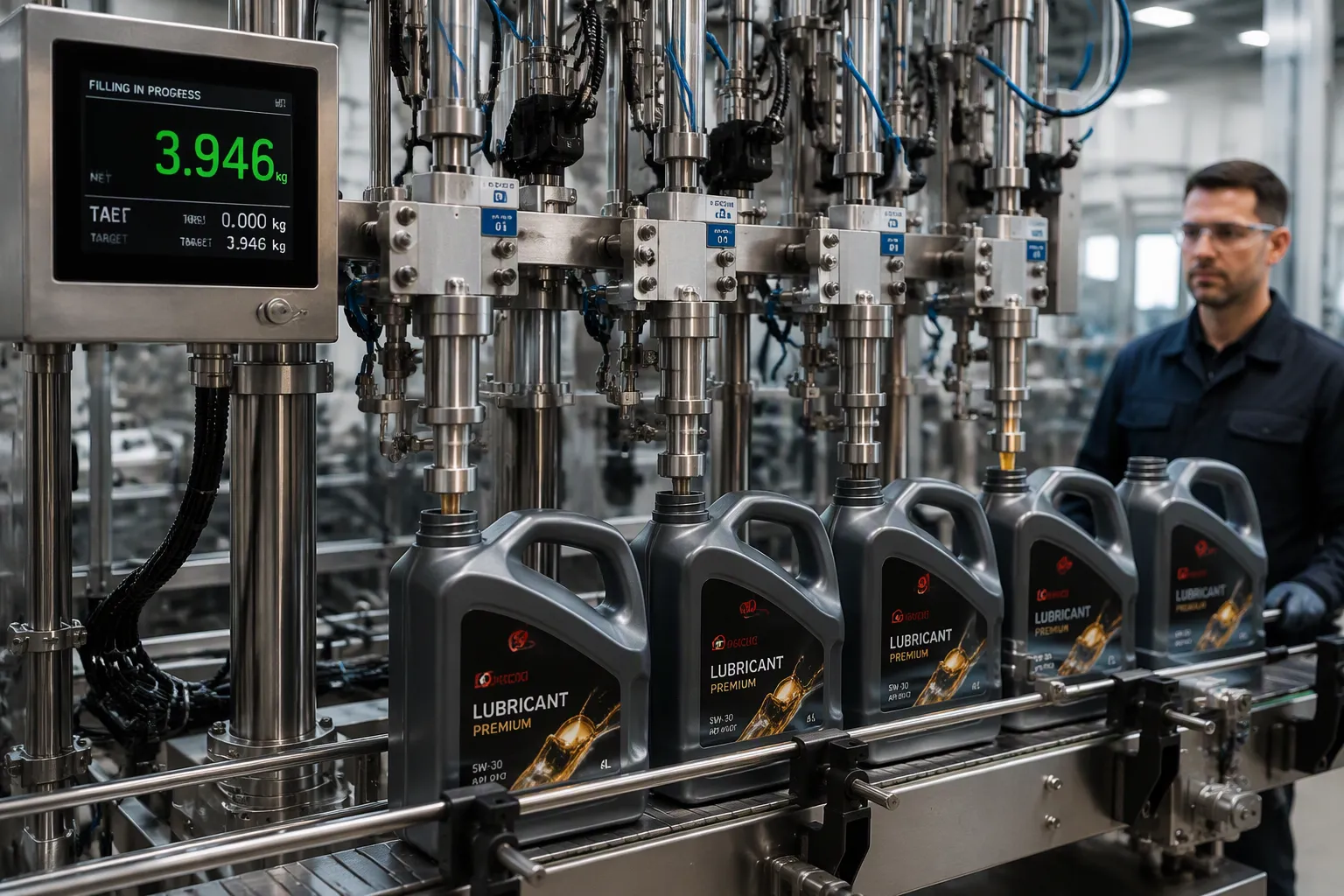
Lubricant filling machines usually come in two main types. Automatic weighing-type fillers give out product by net weight. The machine fills each jerrycan to a target weight and checks it on load cells. This way, the dose matches the real mass of oil delivered. PLC-controlled piston fillers work by mechanical displacement instead. A servo-driven piston pulls a set volume into the cylinder and pushes it out through the nozzle. This design is less affected by trapped air and foaming, so it suits oils that tend to hold bubbles.
Accuracy differs by technology. The table below shows typical tolerances for common filling methods.
Filling Technology | Typical Accuracy |
|---|---|
Gravity | 1–2% |
Overflow | 0.5–1% |
Piston | ~0.5% |
Net weight | 0.1–0.2% |
Weighing-type filling gets the tightest tolerance because it measures the product directly. Filling accuracy is often stated as a tolerance of ±0.5% to ±2%. Servo-driven piston and flow meter fillers usually give the highest accuracy within that range. For chemical products, the target often sits at ±0.3% to ±0.8%. Corrosion-resistant materials such as PTFE and 316L are recommended.
Accuracy, Speed, and Product Handling
Throughput depends on head count. A 12-head lubricant filling machine fills twelve jerrycans at once, so output rises sharply against a single-nozzle unit. Multi-head setups greatly increase throughput by filling multiple containers at the same time. A turnkey lubricant packaging line matches the head count with conveyor speed and capping capacity, so no stage starves the next.
Product handling shapes the filling result. High-viscosity oils such as gear oil resist flow through hoses, valves, and nozzles. This lengthens the fill cycle and can make gravity feeding inadequate. A heated pump option helps thick grades move. Anti-drip nozzles with a back-suction function stop oil from dripping after the fill stops. Stainless steel or chemical-resistant contact parts resist additive-containing oils. Adjustable filling volume and speed, set through a PLC touchscreen, let operators tune the dose for each product.
Changeover between container sizes deserves early attention. Wide-mouth jars and narrow-neck bottles impose different demands on nozzle selection and operating speed. Container opening, height, stability, headspace, and fill position all affect setup. A machine handles different viscosities only when its dosing range, product path, nozzle, controls, and feeding system cover them. Some switches need different recipes, pump speeds, nozzle settings, temperature control, or change parts. Testing should include the most demanding realistic product and the real package. It should also show stable production, not just prove the filler can dispense oil.
Capping: Secure Seals at Line Speed
Capping Methods and Torque Control
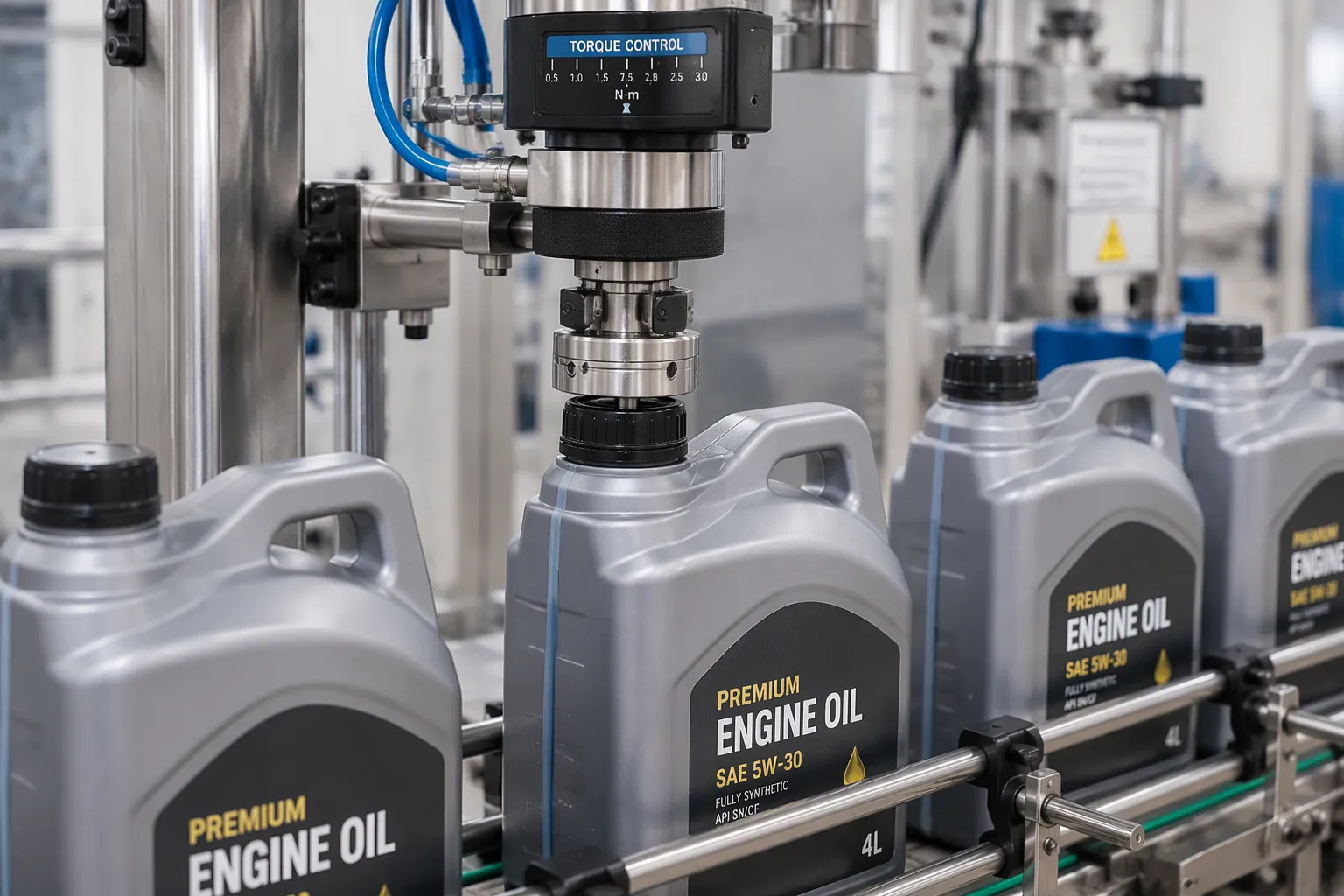
The capping machine feeds, loads, and screws caps onto each jerrycan by itself. It makes a seal that does not leak and holds up through shipping and storage. Torque control decides whether that seal works. Too little torque lets the cap loosen and leak. Too much torque warps the cap or breaks a tamper-evident ring.
Different drive systems control torque in different ways.
Drive System | How Torque Is Controlled | Key Characteristics |
|---|---|---|
Mechanical spring clutch | A preset spring pressure sets the torque | Simple, but it drifts as springs wear out; needs manual recalibration |
Pneumatic clutch | Compressed air adjusts the torque | Torque can be adjusted in real time without stopping the line |
Magnetic clutch | Lets go on its own at the target torque | A non-contact design cuts wear a lot |
Servo system | Constantly checks motor current and corrects in real time | Highest precision; logs torque for each bottle; allows fast, proven changeovers; best for traceability |
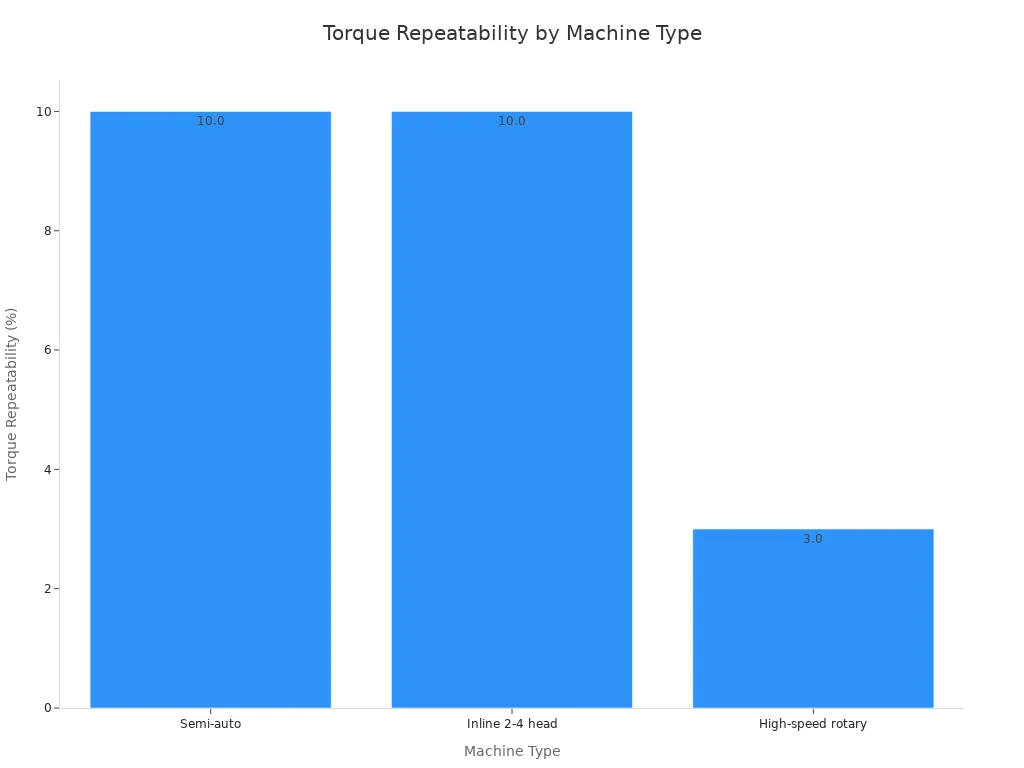
Repeatability depends on the machine class. A semi-auto or single-head unit with a magnetic head holds about ±10%. An inline 2–4 head screw capper reaches ±5–10%. A high-speed rotary capper with servo closed-loop control reaches ±3%, across a 0.2–15 Nm range.
The cap type changes the setup. Pump caps and gun-shaped caps need chucks whose shape matches the cap exactly. If the chuck only partly grips the cap, torque is applied unevenly and the caps come out crooked. Head pressure changes, faster line speeds, and worn spindles all shift the applied torque during a run. Digital torque monitors log every bottle and sound an alarm when readings fall out of range, so they catch this drift before it turns into a defect.
Leak prevention is confirmed through standards compliance and physical testing: ASTM D7860-14(2022) for torque retention of continuous thread closures, ASTM D3475-20 for child-resistant packaging classification, and ISO 13127 for global mechanical test methods on re-closable child-resistant systems. Practical line-side confirmation—inversion tests, vacuum or pressure checks, and hot-fill cool-down cycling—validates that the torque window actually prevents leaks under production conditions.
Integration with Filling
Capping capacity must meet or slightly beat the filling line's target output. About one in five unexpected shutdowns happens because the filler and the capping stage downstream are not in sync. A central PLC coordinates the servo-driven parts of filling and capping in real time. Sensors trigger each stage at the right moment, and deterministic fieldbus protocols such as Profinet, EtherCAT, and EtherNet/IP keep motion tightly coordinated. This coordination runs about 30% quicker than manual setups, with speeds rising about 22% overall.
Head count is the simplest lever. A 4-head capping machine pairs with a multi-head filler so both stages share the same cycle time. A turnkey lubricant packaging line sets this match during configuration, and accumulation space between stations absorbs short stops. Buyers should compare actual throughput, cap compatibility, and changeover needs rather than advertised speeds alone.
Carton Packing on a Turnkey Lubricant Packaging Line
Case Packing and Sealing
A built-in laner takes filled and capped jerrycans from the conveyor. It sorts them into separate lanes and groups each lane into the pack pattern the buyer picks. The case packer then lifts each group and loads it into an open carton. This laner step keeps containers lined up, so the packer places them in the right count and direction without manual handling.
The automatic carton packing machine then closes each case and gets it ready for palletizing. Sealing options vary by carton construction and production needs.
Sealing Method | How It Works | Palletizing Preparation |
|---|---|---|
Tape sealing | Applies tape along top, bottom, and edges; supports standard sealing, corner reinforcement, H-pattern taping, or orbital wrapping | Integrated lines combine loading, top sealing, and downstream handling |
Hot-melt adhesive | Bonds carton flaps with glue via an adhesive flap sealer | Sealing feeds into palletizing and wrapping on specified lines |
Tuck-in closure | Folds and inserts flaps with no glue or tape | Fits integrated erecting, packing, and sealing lines |
Case erecting + bottom sealing | Forms empty cases and seals the bottom before loading | Combines packing, top sealing, and downstream operations |
Tape versus hot-melt depends on carton construction, the required closure, production speed, and consumables.
Palletizing and Line-End Automation
A robotic palletizer takes sealed cases and stacks them in the required pattern. Synchronized speed keeps every component moving in rhythm, so secondary packaging never becomes a bottleneck for primary filling. Quick changeovers let the line switch between SKUs and box sizes with minimal downtime. Robotic palletizers handle multiple SKUs where conventional units are limited to single-SKU runs.
Integration pays off across the whole line. Aagard, a packaging systems manufacturer serving automotive fluids and specialty chemicals, notes that combining cartoning, case packing, and palletizing into one solution reduces transfer points and improves throughput. A single solution also delivers better control, simplified installation, and a more compact footprint. Simulation-based automation approaches help optimize line efficiency for common package sizes such as 1L and 4L. A well-matched turnkey lubricant packaging line therefore carries jerrycans from filling to pallet with minimal handling.
A turnkey lubricant packaging line moves jerrycans through three linked stages. Filling puts the right amount into each container with steady accuracy. Capping tightens a seal that will not leak. Carton packing lanes the jerrycans, loads them into cases, and seals each case. The whole flow runs as one coordinated system.
A single-supplier approach brings clear benefits:
Coordination: one partner is in charge of every phase, so vendors do not blame each other when something goes wrong.
Throughput: engineering, controls, and commissioning teams work together from day one, which shortens the schedule.
Integration risk: the partner owns the result from start to finish, which cuts scope gaps and change orders.
Buyers should match line speed to production targets, confirm the container size range, and pick an automation level that fits their output. A well-matched Turnkey Lubricant Packaging Line then supports reliable, repeatable lubricant packaging operations.
FAQ
What container sizes can one turnkey lubricant packaging line handle?
A single line can cover a wide range. Small bottles run from 100 ml up to 5 L. Jerrycans and buckets span 4 L to 30 L. Steel drums reach 200 L, and IBC totes reach 1,000 L with a drum-station attachment. Format-change parts let the same line switch between these sizes.
How accurate is jerrycan filling on these lines?
Accuracy depends on the filler type. Net-weight filling holds the tightest tolerance at roughly 0.1% to 0.2%. Piston fillers sit near 0.5%. Gravity filling is the loosest at 1% to 2%. A turnkey line matches the filler to the product and the target dose.
How does capping keep seals leak-free at high speed?
Torque control does the work. Servo closed-loop capping holds about ±3% repeatability across a 0.2–15 Nm range. Digital torque monitors log every bottle and alarm when readings drift out of range. Chucks shaped to the cap, including pump and gun-shaped caps, apply torque evenly.
Why pair a 4-head capping machine with a 12-head filler?
Head count sets the cycle time. A 12-head filler fills twelve jerrycans per cycle. A 4-head capper must then match that output, or the filler starves. The supplier balances both stages during configuration, and accumulation space between stations absorbs short stops.
What does carton packing add to the line?
An integrated laner sorts filled and capped jerrycans into lanes. The case packer then loads them into cartons in the chosen pack pattern. A sealer closes each case by tape, hot-melt adhesive, or tuck-in closure. A robotic palletizer stacks the sealed cases for shipment.
Recommended Products

lubricant pail filling machine

Monoblock Filling And Capping Machine For Lubricant

Automatic lubricant /coatings pail filling machine

DGP-CZ-200R weighing style filling machine for barrels suitable for lubricant

Mode DGP-CZ-2B weighing lubricant filling machine

Intelligent weighing style lubricant filling machine


Recent News
1.Tom's Group was appointed as "Director Unit of Filling Equipment and Packaging Materials Committee" and won the award of "Excellent Service Provider in Lubricant Industry"!
2025-04-182.Top 10 Lubricant Filling Machine Manufacturers in China for 2026
2026-02-043.Automated Weighing Filling Lines Improve Efficiency for Lubricant Production Plants
2026-08-314.Guide to Filling Lines for Pesticide, Lubricant Oil, and Detergent
2024-12-185.Advantages of Automated Lubricant Filling Machines
2025-01-226.Choosing the Right Lubricant Filling Machine
2025-01-267.Advancements in Lubricant Filling Technology
2025-03-138.The Comprehensive Guide to Lubricant Oil Filling Machines
2024-10-259.The Importance of Lubricant Oil Filling Machines in Modern Industry
2024-09-2510.how to choose the Petrochemical And Lubricant Filling Machines?
2024-08-05