



How Turnkey Packaging Lines Support Global Daily Chemical Manufacturers Expand Capacity
 Oct 08, 2026|
 View:19
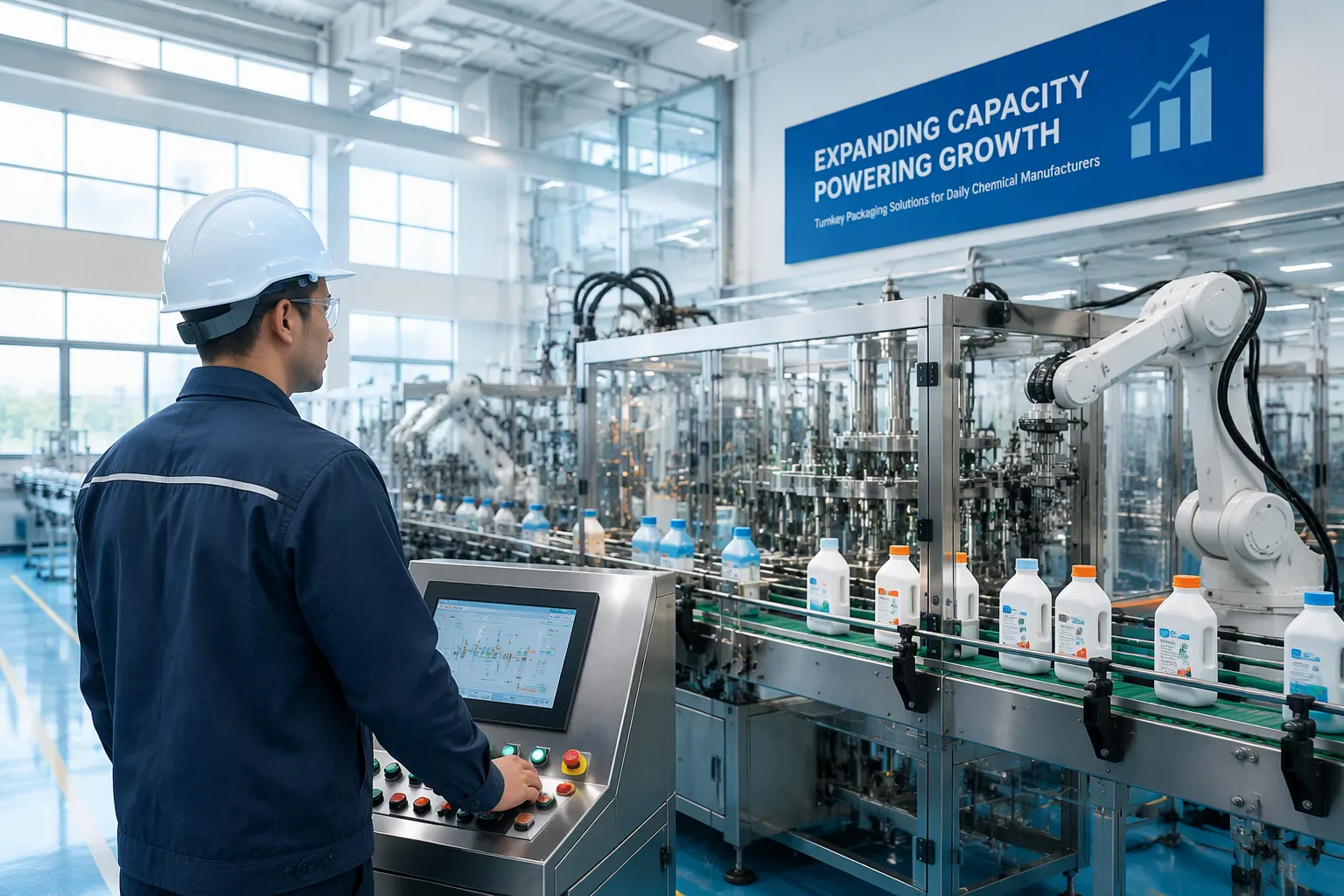
Turnkey Packaging Lines help global daily chemical manufacturers expand capacity through one complete, integrated packaging solution. A single supplier delivers the whole line, from filling and capping to labeling and palletizing. This approach shortens lead times, simplifies compliance, and scales with production needs.
Operations managers, production engineers, and executives all face the same question: which expansion path delivers reliable output fastest? Integrated lines answer that question with faster market entry, modular scalability, built-in regulatory readiness, and predictable cost efficiency. Each benefit directly supports higher daily output and lower operational risk. Decision-makers gain a clear, practical basis for comparing capacity expansion options.

Key Takeaways
A turnkey packaging line comes from one supplier. This one source takes care of everything from filling to palletizing.
Turnkey lines help you get to market faster. One contract and one team cut the time from order to first production.
Modular designs let you start small and add modules as demand grows. This protects the money you put in at the start.
Turnkey lines include compliance from the start. GMP design and single-point accountability cut down on audit delays.
Cost efficiency gets better with less coordination and faster startup. Your capital starts earning sooner.
Turnkey Line Components
Defining the Turnkey Model
A turnkey packaging line comes as one complete, connected system. One supplier is in charge of the whole job, from filling and capping to labeling and palletizing. The manufacturer has one contract, one setup schedule, and one contact for service.
The layout you pick shapes how the line performs over time. Mono-block designs put several functions into one small frame. Modular designs connect separate machines along a conveyor. Each layout fits a different way of working.
Factor | Mono-block layout | Modular layout |
|---|---|---|
Footprint | Small; functions share one frame | Longer conveyor runs and service space |
Changeover | Good for a few steady formats | Works well across many formats |
Expansion | Limited by the first frame design | Strong; modules are easy to add or swap |
Maintenance | Fewer transfer points; one fault can hit several operations | Faulty modules can be isolated cleanly |
Mono-block layouts fit tight floor space and a simple, steady product range. Modular layouts suit many SKUs, portfolio growth, and step-by-step investment. Suppliers build either layout around the customer's bottles, caps, and output goals.
Core Equipment and Layouts
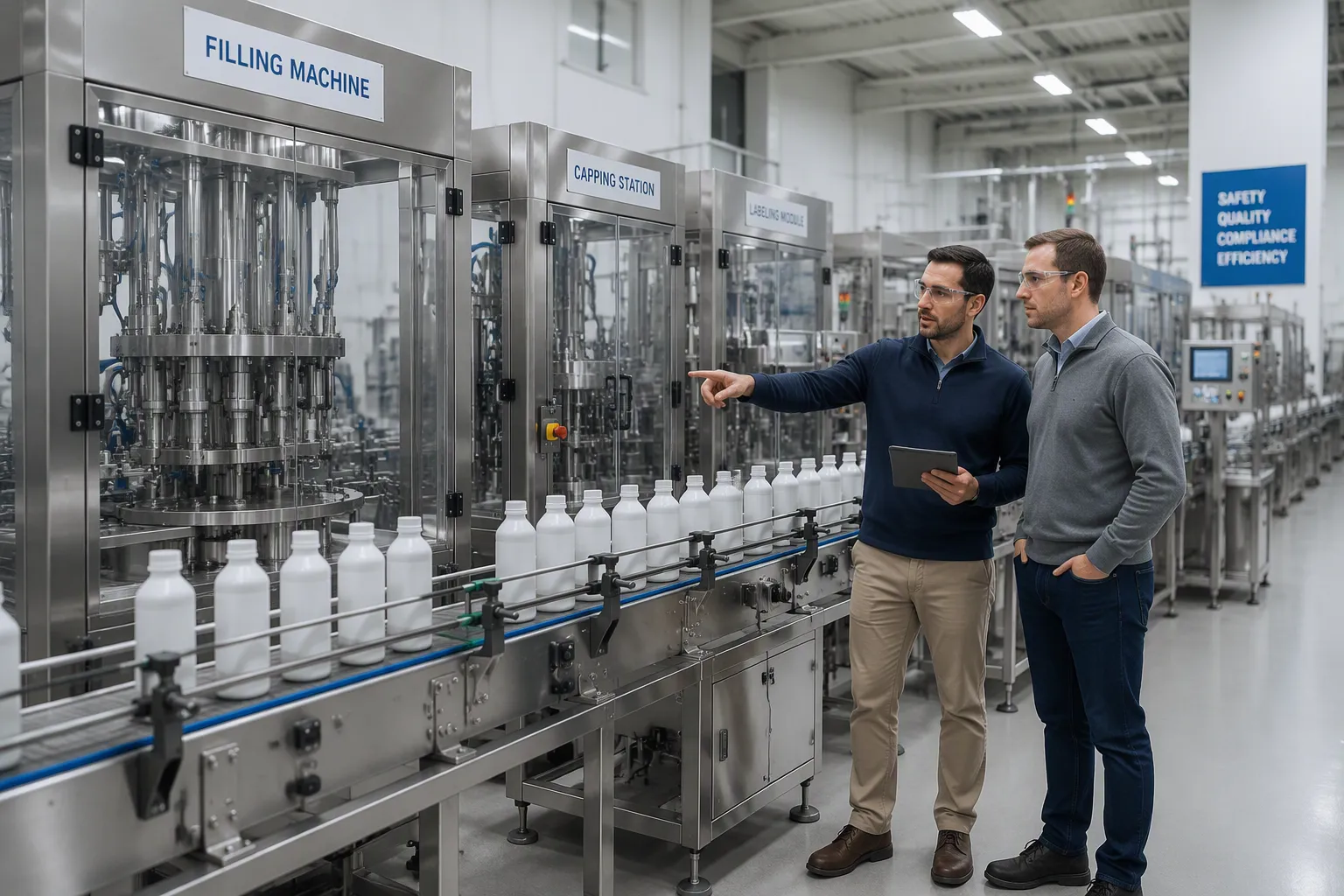
A full line joins several machine groups. Each group does a set task and passes the product to the next stage. Common parts include:
Bottle unscramblers and container rinsers
Filling machines (piston, weighing, pressure, and tracking types)
Capping machines and induction sealers
Labeling machines and fill-level inspection
Carton sealers, case packers, and shrink wrap bundlers
Pallet dispensers, palletizers, and pallet wrappers
Conveyors, turntables, and bag packing machines
Jiangsu Tom Intelligent Equipment Co., Ltd. shows this model well. Started in 1998, the company has more than 27 years of experience and has sold over 4,000 shampoo filling lines worldwide. Its team has more than 100 designers and engineers, plus over 100 after-sales technicians.
The company handles single-machine projects and full turnkey lines. A manufacturer can start with one filler and add capping, labeling, and palletizing modules later. This step-by-step path lowers the first capital risk and keeps expansion options open.
Expansion Challenges for Global Manufacturers
Speed, Scale, and Multi-Market Pressure
Demand for daily chemical products keeps going up. Many plants still use manual or semi-automatic equipment. These systems have a hard time keeping up with growing order volumes. Output stops growing, overtime costs rise, and delivery windows get tighter. The clear next step is a full automation upgrade, but that step carries real risk for a plant built around older machines.
Entering several countries adds more pressure. Each market has its own bottle shapes, cap types, and product formulas. Trigger spray caps, pump caps, flip-top caps, round caps, and metal caps all need different handling. Corrosive products like bleach and disinfectants damage standard parts. A line that runs one format well may struggle across a wider product mix.
Compliance and Cost Hurdles
Rules differ from market to market. GMP expectations shape equipment design, cleaning access, and documentation. Packaging must also survive the stresses of transport and storage. The table below sums up the main compliance hurdles.
Compliance Hurdle | Description | Regulatory Driver |
|---|---|---|
Regulatory standards | Container choice, labeling, and transport papers must follow detailed rules; UN codes (X/Y/Z) must match product specific gravity and vapor pressure | DOT (49 CFR), EPA, FDA, UN |
Material compatibility | Packaging must resist corrosion, leaching, and aging; permeation limits are ≤0.5% for Division 6.1 and ≤2.0% for others | 49 CFR 173.24 |
Transport stresses | Packaging must withstand shock, vibration, and pressure changes; pressure ratings are 250 kPa for Group I and 100 kPa for air shipments in Groups II/III | 49 CFR; UN packing groups |
Labeling and documentation | Artwork approval, automated label checks, multi-language templates, and audit records | FDA/EMA labeling rules |
Packaging and labeling failures are a major compliance risk: 33% of medication errors come from packaging and labeling issues, and these play a part in 30% of related deaths.
Capital and lead-time risk make these hurdles harder. Expansion projects tie up large sums of money before the first bottle ships. A poorly ordered project delays revenue and puts pressure on cash flow.
How Turnkey Packaging Lines Enable Expansion
Faster Market Entry and Scalable Output
Speed decides who wins a growing market. One supplier takes away the coordination work that slows projects with many vendors. One contract covers engineering, manufacturing, installation, and commissioning. The manufacturer avoids the gaps that open when separate vendors hand off responsibility. Jiangsu Tom Intelligent Equipment Co., Ltd. backs this model with more than 100 designers and engineers and over 100 after-sales technicians. That depth shortens the trip from order to first production run.
Commissioning speed matters as much as build speed. A pre-integrated line shows up with tested machine interfaces and matched conveyor speeds. Startup teams spend less time fixing transfer points and more time running product. Faster commissioning turns capital into revenue sooner, and that early output directly supports capacity expansion.
Scalability keeps the expansion path open. Modular designs let a plant add capping, labeling, or palletizing modules as demand grows. A manufacturer can start with a single filler and expand later without replacing the first machine. This step-by-step approach lowers initial capital risk and protects the original investment. Turnkey Packaging Lines therefore serve both the first expansion phase and every phase that follows.
Compliance Readiness and Cost Efficiency
Compliance shapes equipment design from the first drawing. GMP expectations drive smooth surfaces, accessible cleaning points, and documented material choices. A line built to these standards passes audits with less rework. The manufacturer avoids the costly cycle of retrofit, re-inspection, and delayed launch. Compliance readiness becomes a direct enabler of capacity expansion, because approved lines start producing without regulatory delays.
Operational complexity falls when one supplier owns the whole line. Spare parts come from one source. Service teams know every module. Training covers one system instead of several. Maintenance schedules line up across the full line. These gains cut downtime and free plant staff for production work.
The turnkey contract model makes the business side simpler too. One agreement fixes scope, schedule, and responsibility. Budgets become predictable, and change orders stay contained. Manufacturers gain the same clarity that contract manufacturing offers, without giving up control of their own plant. Turnkey Packaging Lines thus reduce both the technical and the financial friction of expansion.
Cost efficiency follows from these gains. Less coordination means lower engineering overhead. Faster commissioning means earlier revenue. Modular growth means capital arrives in step with demand. Each factor builds on the return on the original investment and makes the next expansion easier to justify.
Technical Fit and Global Compliance
Performance for Daily Chemical Products
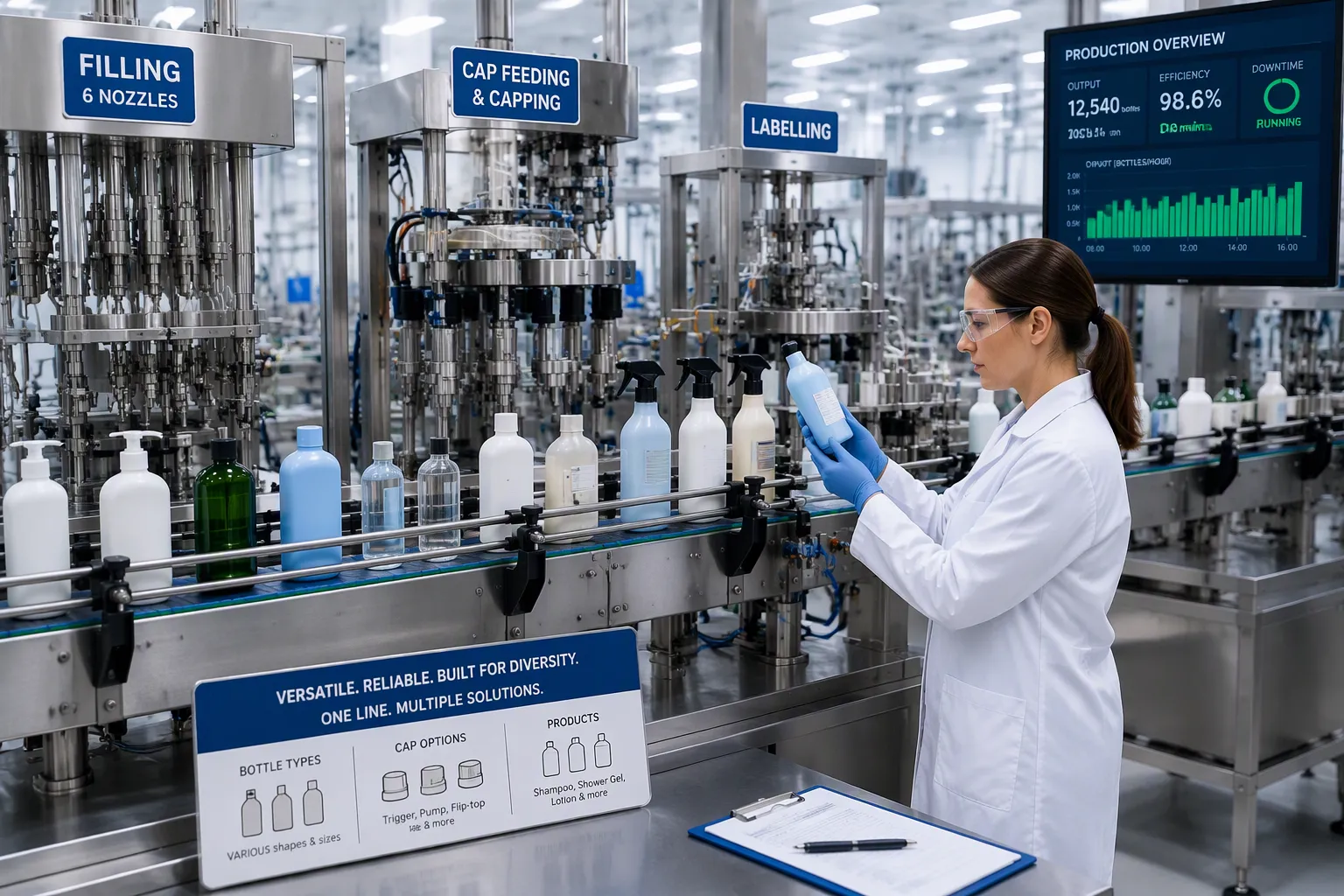
Daily chemical production includes shampoos, shower gels, laundry detergents, disinfectants, cosmetics, lotions, and creams. Each product has its own needs. Filling amounts range from 100ml up to 3000ml. How corrosive a product is varies a lot across the lineup. Bottle shapes can be uneven, and caps come as trigger spray, pump, flip-top, round, or metal types. A line must handle this mix without constant tweaking. Jiangsu Tom Intelligent Equipment Co., Ltd. builds equipment around these factors and has sold more than 4,000 shampoo filling lines worldwide.
Integrated lines for shampoo and shower gel show the usual operating range:
Parameter | Stated Value | Conditions / Notes |
|---|---|---|
Filling volume range | 100–3000 ml | Applies to the ZS-FAL180X20 integrated line for shampoo, conditioner, shower gel, lotion, detergent, and hand wash |
Production speed | ~20–80 bottles per minute | Varies with product type, filling volume, bottle specification, and operating conditions |
Line type | Integrated automatic line (tracking filling, cap feeding, four-wheel capping, bottle positioning, double-side labeling, continuous conveying, finished-bottle collection) | Designed for shampoo, shower gel, and similar liquid personal-care products |
Specific models extend that fit across the product range. The DGP-12S non-metal laundry detergent filler covers 50ml to 5000ml at up to 40 bottles per minute. The DGP-24X-SL rotary bleach filler runs 24 heads at up to 8,000 bottles per hour. The DGP-CZ automatic weighing filler handles 1kg to 30kg with high accuracy. The DGP-GS-6E automatic cream filling machine meets GMP standards. Together these machines cover thin liquids, corrosive products, heavy containers, and thick creams. A plant matches each machine to its product family and keeps one service partner across the whole range.
Meeting Multi-Market Rules
GMP by design shapes surfaces, cleaning access, and documentation from the first drawing. Single-source project management keeps one team accountable for safety, guarding, and training across the line. Buyers should confirm the line meets regional safety standards such as CE for Europe and UL for North America, plus sector rules like FDA for food and pharmaceuticals. They should ask for compliance certificates as proof of conformity. Emergency stop systems must be easy to reach and clearly labeled. Moving parts need guards, and safety interlocks must stop operation when guards open. Operator training on safe operation, maintenance, and troubleshooting belongs in the contract.
Turnkey Packaging Lines support varied market requirements through this single point of accountability. One supplier maps the target markets, documents conformity, and adjusts the design before build. That approach reduces late surprises at audit time.
Working with a certified partner does not transfer their certification to your product. A B Corp manufacturer allows you to describe your supply partner accurately; it does not make your product certified. Write claims about what you can evidence, at the level you can evidence it.
ROI and Alternative Options
Cost Considerations and Returns
The money you pay upfront is only one part of the cost picture. Lead time ties up capital before the first bottle ships. How fast the line starts up decides when that capital starts earning. Labor efficiency then shapes the ongoing cost base. Labor costs run at a minimum of roughly $30,000 per year per worker. A fully automatic conveyorized stretch wrapper costing about $45,000 can pay back its investment in about 18 months through labor savings. Leasing the same equipment costs under $1,400 per month on a 36-month term with a $1.00 buyout, usually far less than current labor costs.
Automation also cuts indirect costs. Fewer manual case erecting, packing, and palletizing tasks mean fewer ergonomic injuries, lower turnover, and less downtime. Once deployed, these systems run with minimal operator oversight. A documented case, McAlpine & Co. Ltd, achieved 24/5 operations with no human intervention and 100% automation of case packing, which allowed labor reallocation. Long-term scalability adds further return, because modular lines accept new modules as demand grows.
Comparing Expansion Paths
Three paths exist: a turnkey line, an in-house build, and an upgrade of existing equipment. Each fits different conditions.
Factor | Turnkey line | In-house build | Upgrade existing line |
|---|---|---|---|
Technical performance | One supplier owns integration and can be held to a line-level output number | Buyer's engineers own interfaces; accountability splits across suppliers | Best where surrounding equipment already runs well |
Application fit | Strong for demanding products and greenfield sites | Fits evolving product specs and staged budgets | Fits a single weak stage |
Compliance | Single point of accountability | Buyer coordinates documentation | Depends on existing documentation |
Cost | One contract, predictable scope | Spread across budget years | Lowest entry cost |
Both routes deliver excellent results, and the same engineering work must happen either way. Turnkey Packaging Lines suit greenfield projects, demanding products, and cases where a contractual line-level performance number matters. An in-house build suits plants with engineering capacity and documented interfaces. An upgrade suits a plant replacing one stage.
Turnkey Packaging Lines help plants grow by bringing together connected equipment, quicker setup, flexible design, and compliance that is ready from the start. One supplier is in charge of the whole line, so projects go from order to first production run with fewer handoffs.
Speed, scalability, regulatory fit, and return on investment all support each other. Faster commissioning turns capital into revenue sooner. Modular layouts let plants add capping, labeling, or palletizing as demand grows. GMP-driven design passes audits with less rework.
Decision-makers comparing expansion paths should match the option to their plant. A greenfield site, a demanding product mix, or a contractual output number favors a turnkey line. Existing engineering capacity favors an in-house build. A single weak stage favors an upgrade.
FAQ
What does a turnkey packaging line include?
A turnkey line covers the whole packaging flow. It begins with bottle unscrambling and filling, then goes through capping, labeling, and inspection. Carton sealing, case packing, and palletizing complete the job. One supplier delivers the entire system and takes single-point responsibility for integration, installation, and service.
Can a plant start small and expand later?
Yes. Modular designs let a manufacturer begin with one machine, like a filler, and add capping, labeling, or palletizing modules as demand grows. Jiangsu Tom Intelligent Equipment Co., Ltd. supports both single-machine projects and full turnkey lines, so the first investment stays protected.
How do these lines handle corrosive products and varied caps?
Equipment handles different corrosive levels through matched materials and seals. Filling machines cover thin liquids, bleach, heavy containers, and thick creams. Capping stations accept trigger spray, pump, flip-top, round, and metal caps. This range lets one line serve a wide daily chemical portfolio.
How does a turnkey line support regulatory compliance?
GMP by design shapes surfaces, cleaning access, and documentation from the first drawing. One project team stays accountable for safety guarding, training, and conformity records. Buyers should confirm regional standards such as CE for Europe and UL for North America, and ask for compliance certificates as proof.
What filling volumes and speeds can the equipment reach?
Coverage runs from 100ml up to 3000ml. The DGP-12S handles 50ml to 5000ml at up to 40 bottles per minute. The DGP-24X-SL rotary bleach filler runs 24 heads at up to 8,000 bottles per hour. The DGP-CZ weighing filler covers 1kg to 30kg.