





The Leading Choice for Advanced Oil Filling Lines
 Sep 26, 2025|
 View:1470
In modern industrial production, oil filling lines, as a key step in liquid product packaging, have become indispensable core equipment in the production of various oil products, including edible oil, lubricants, and fuel oil. With the rapid development of automation technology, oil filling lines have achieved significant improvements in precision, efficiency, and intelligence.
Diverse Filling Capacity Range
Modern oil filling lines offer a wide range of technical parameters to meet the needs of businesses of varying sizes and production requirements. In terms of filling capacity, they primarily cover a range from 0.1 liter to 208 liters, specifically categorized into the following main grades:
Small packages (0.1-1 liter) are primarily targeted at the household market, such as edible oils like peanut oil and olive oil for daily cooking.
Medium packages (1-6 liters) are suitable for the catering industry and bulk purchases by households and are the most common packaging size on the market.
Large industrial packages, including 60L-200L industrial drums and 1000L IBCs, are primarily used for large-capacity storage and transportation in industries such as chemicals and lubricants.
This tiered capacity design allows manufacturers to flexibly select packaging solutions based on product usage and market positioning, maximizing the satisfaction of diverse customer segments. Notably, modern filling lines often utilize a modular design, allowing for rapid adjustment of filling capacity by replacing components, significantly enhancing equipment flexibility and adaptability.
Optimizing the Balance between Production Speed and Efficiency
Filling speed is a key performance metric for a production line, directly impacting a company's production capacity and operating costs. Oil filling line production speeds vary significantly depending on packaging capacity and the degree of automation:
For small and medium-sized packaging (0.1-6 liters), filling speeds typically range from 300 to 1,500 bottles per hour, with high-efficiency lines exceeding 2,000 bottles per hour.
For large industrial packaging (e.g., 200L capacity), filling speeds are relatively slow, typically around 25-30 barrels per hour (single-station filling). This is primarily due to the time and safety requirements of large-volume filling.
Factors influencing filling speed include oil viscosity, the number of filling valves, and control system efficiency. Modern, advanced filling lines utilize dual-flow filling technology, with a fast-first, slow-down flow rate. This technology uses a high flow rate for rapid filling at the initial filling stage and switches to a low flow rate for precise filling as the target volume is approached. This improves efficiency and ensures precision.
Compatibility of Container Materials and Filling Technology
Oil filling lines must accommodate containers made of various materials, including plastic (PET, PE), glass, and metal. The choice of container material directly impacts the design and filling methods of the filling line:
Plastic containers are the mainstream packaging choice for edible oils and lubricants due to their lightness, durability, and low cost. Filling lines require flexible clamping mechanisms to prevent deformation.
Glass containers are primarily used for high-end edible oils and specialty oils. Filling lines must consider their fragility and employ gentle conveying and positioning mechanisms.
Metal containers are commonly used for industrial lubricants and chemical oils, requiring stronger structures to accommodate their weight and rigidity.
Modern filling lines utilize appropriate technologies for different container materials: Anti-drip filling valves prevent oil from contaminating the container exterior and production line; vision-addressable positioning systems automatically identify the barrel opening, making them particularly suitable for automated filling of large industrial barrels; and subsurface filling technology reduces foaming, making it particularly suitable for oils prone to foaming.
Wide Coverage of Multi-Industry Applications
Oil filling line designs exhibit significant specialization based on the application requirements of different industries:
Edible Oil Industry: Filling lines place particular emphasis on hygiene standards, typically utilizing stainless steel and GMP-compliant designs. This type of equipment must accommodate the filling requirements of a variety of edible oils, including peanut oil, olive oil, rapeseed oil, and blended oils, ensuring food safety.
Lubricant Oil Industry: This includes machinery lubricants, compressor oils, turbine oils, and more. Filling lines must consider the viscosity and potential chemical properties of the oil and are typically equipped with specialized filtration systems and viscosity adaptation devices.
Chemical oils, such as fuel oil and solvent oil, can be volatile or toxic, requiring explosion-proof and environmentally friendly designs. For these oils, filling lines are typically equipped with gas protection systems and specialized sealing designs to ensure safe operation.
High-value specialty oils, such as cosmetic and pharmaceutical oils, typically require higher precision and stricter environmental control. Filling accuracies can reach ±0.2% or even higher.
Core Mechanical Components and Functions of a Oil Filling Line
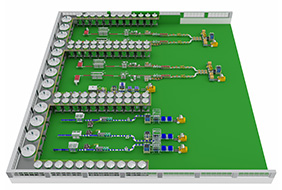
A complete, fully automated oil filling line consists of multiple coordinated mechanical systems, forming a highly integrated production system.
The filling machine is the core of the production line and can be categorized by metering principle: volumetric or gravimetric. Volumetric fillers typically utilize high-precision oval gear flowmeters or servo-controlled piston technology and are suitable for medium- and low-viscosity oils. Gravimetric fillers utilize load cells and are particularly suitable for high-viscosity oils and large-volume filling.
The container handling system includes a bottle unscrambler, conveyor belt, and positioning device. Conveyor belts typically utilize variable frequency drive (VFD) speed regulation for smooth transitions and precise positioning. The system is equipped with appropriate clamping and positioning mechanisms for different container shapes and materials to ensure container stability during the filling process.
The capping and sealing system is responsible for sealing the containers. Depending on the cap type (screw cap, press cap, etc.), the system includes a screw capper, a press capper, and other machines. Advanced production lines utilize star-wheel conveyors and capping robots for high-speed and efficient capping.
The labeling and packaging system, including labelers, inkjet printers, and casers, is responsible for labeling and subsequent packaging of containers. Modern labelers can achieve processing speeds of 100-4000 bph to meet varying production cycle requirements.
Auxiliary systems include oil filtration, nitrogen protection systems (for easily oxidized oils), heating systems (for high-viscosity oils), and cleaning systems. These systems ensure quality control and operational safety during the filling process.
Technological Advantages and Innovative Development Trends
Modern oil filling lines offer multiple significant advantages over traditional filling equipment:
High-precision filling: Modern equipment generally achieves a high accuracy of ±0.5% FS, with some specialized equipment even achieving an extremely high accuracy of ±0.2%, effectively reducing product loss.
High-efficiency production: The parallel operation of multiple filling heads (typically 6-12, and sometimes up to 32) and optimized filling processes significantly improve production efficiency.
Flexibility and adaptability: The modular design enables the same production line to accommodate filling needs of varying capacities and oil grades, allowing for rapid switching between production modes.
Intelligent control: The use of PLCs (programmable logic controllers) and touchscreen human-machine interfaces enables intelligent parameter setting, process monitoring, and fault diagnosis.
Future oil filling line technology is moving towards intelligent, flexible, and green development. Internet of Things technology enables remote monitoring and data collection and analysis; modular design supports small-batch, high-variety production; and explosion-proof design and environmental protection measures are standard features.
The TOM Packaging Advantage
TOM Packaging distinguishes itself through several key advantages that make it the preferred choice for oil filling operations worldwide:
Engineering Expertise and Experience
With roots dating back to 2003, TOM Packaging has accumulated nearly two decades of specialized experience in packaging machinery. The company's foundation in Jiangsu Province, a hub of Chinese manufacturing, provides access to exceptional technical talent and manufacturing capabilities. This longevity translates into refined designs and proven reliability in demanding production environments.
Customization Capabilities
Unlike many competitors offering standardized solutions, TOM Packaging specializes in developing customized systems tailored to specific client requirements. This approach recognizes that each production facility has unique space constraints, product characteristics, and output goals. TOM's engineering team works closely with clients to design solutions that integrate seamlessly into existing operations while accommodating future growth.
Focus on Automation and "Unmanned" Operations
A core philosophy driving TOM's design approach is the creation of increasingly automated systems that reduce labor requirements while improving consistency. Their equipment incorporates smart sensors and PLC-based control systems that monitor operation parameters in real-time, automatically adjusting for optimal performance. This focus aligns with industry trends toward lights-out manufacturing in appropriate applications.
Comprehensive Quality Assurance
TOM Packaging maintains rigorous quality standards throughout the manufacturing process, utilizing premium materials and components. Their systems are designed for long service life with minimal maintenance requirements, delivering exceptional value over the equipment lifecycle. This reliability translates into reduced downtime and higher overall equipment effectiveness for clients.
Integrated Technical Support
Beyond equipment supply, TOM provides comprehensive support services including installation supervision, operator training, preventive maintenance programs, and responsive spare parts supply. This holistic approach ensures that clients maximize their investment through uninterrupted operation and optimized performance.
In the highly competitive world of oil production and distribution, the selection of filling equipment represents a strategic decision with far-reaching implications for operational efficiency, product quality, and profitability. TOM Packaging Factory has established itself as a industry leader by combining technical expertise with practical understanding of production challenges, delivering solutions that consistently outperform expectations.
The company's commitment to innovation, quality, and customer-focused design makes it the optimal choice for businesses seeking to enhance their packaging operations. By partnering with TOM Packaging, oil producers gain not just equipment, but a comprehensive solution that drives operational excellence across their packaging activities. As industry demands continue to evolve, TOM's forward-looking approach ensures that clients remain at the forefront of packaging technology and efficiency.
Whether managing a specialized artisanal operation or a large-scale industrial production facility, TOM Packaging offers the expertise and technology to transform oil filling from a necessary process into a competitive advantage.